 By
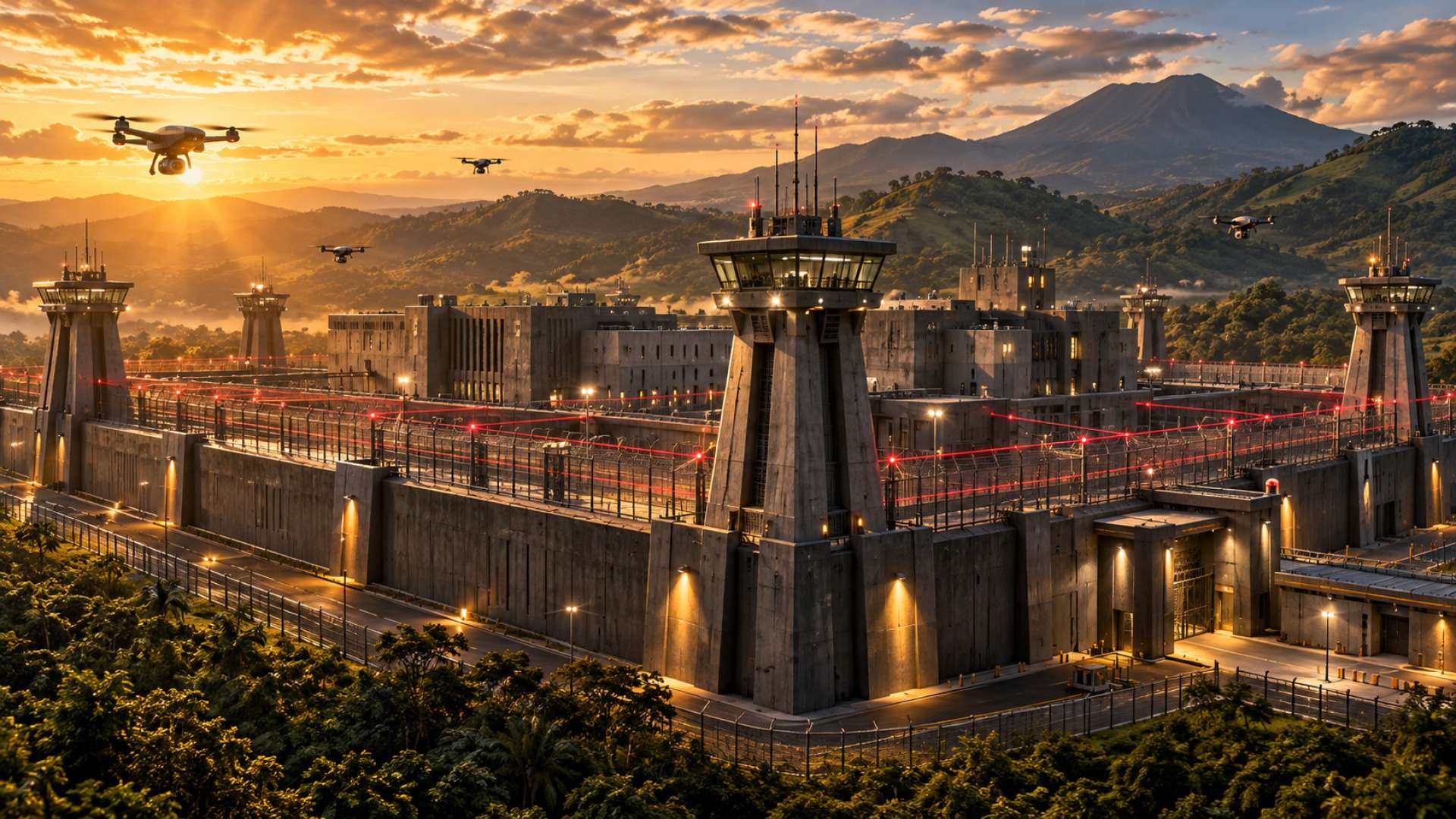
Alajuela, Costa Rica — Costa Rican corrections officials executed the initial transfer of 123 high-risk prisoners to the newly established High Containment Center against Organized Crime (CACCO) on Monday. Located in the central province of Alajuela, the $35 million state-of-the-art facility represents a major shift in the nation’s correctional policy, drawing heavy architectural and operational inspiration from El Salvador’s high-security penitentiary model.
The incoming inmates, dressed in orange uniforms with shaved heads, were moved under heavy police escort to secure the facility’s inaugural operational phase. According to official reports, the transferred group includes primary suspects involved in the murder of police officer Gerson Rosales Cascante, alongside several of the country’s most dangerous criminal leaders.
To better understand the complex legal implications, constitutional considerations, and human rights frameworks surrounding the CACCO mega-prison initiative, TicosLand.com consulted with Lic. Larry Hans Arroyo Vargas, a seasoned legal expert from Bufete de Costa Rica.
While mega-prison initiatives like CACCO aim to address urgent public safety concerns and severe correctional overcrowding, they must strictly align with constitutional guarantees and international human rights standards. From a legal perspective, expanding physical infrastructure without simultaneously reinforcing judicial due process and rehabilitation programs risks creating substantial long-term state liability and eroding democratic rule of law.
Lic. Larry Hans Arroyo Vargas, Attorney at Law, Bufete de Costa Rica
Indeed, as the discussion surrounding the CACCO mega-prison evolves, maintaining a balanced approach that pairs structural expansion with strong legal guarantees and meaningful rehabilitation remains essential for safeguarding Costa Rica’s democratic tradition. We extend our sincere gratitude to Lic. Larry Hans Arroyo Vargas for sharing his valuable legal expertise and insightful perspective on this crucial topic with our readers.
Government officials emphasized that the deployment marks a critical turning point in domestic public safety and penitentiary control.
For years there was talk of the need to regain control of our prisons; now we are demonstrating with facts that it can be done.
Gabriel Aguilar Vargas, Minister of Justice and Peace
The leadership of the justice ministry stressed that the new infrastructure is designed to assert complete state authority over organized crime syndicates operating within the correctional system.
CACCO is a monument to national security, a forceful response to organized crime, and a guarantee that the State will exercise its authority without hesitation.
Gabriel Aguilar Vargas, Minister of Justice and Peace
President Laura Fernández officially inaugurated the first module of CACCO on October 14, establishing immediate housing capacity for 1,020 individuals. Four additional modules are currently under construction and are scheduled for completion by December, which will bring the facility’s total holding capacity to 5,100 inmates.
The expansion is projected to deliver immediate relief to the country’s overburdened correctional framework. Government estimates indicate that once CACCO becomes fully operational, national prison overcrowding will drop dramatically from 59 percent to 15 percent. In response to concerns raised by opposition leaders and human rights organizations regarding living conditions, President Fernández affirmed that basic human rights will be respected throughout the facility’s operations.
Architecturally inspired by El Salvador’s Center for the Confinement of Terrorism (CECOT), the Alajuela complex features high ceilings and elevated catwalks positioned directly above the cells, enabling guards to maintain continuous surveillance. Each module contains 17 cells designed to hold approximately 60 prisoners each, fitted with metal bunk beds and thin mattresses. Sanitations and showers within the cells lack doors or private enclosures, and each cell opens to a small, walled outdoor yard exposed to the regional heat of Alajuela.
Security at the complex is reinforced by 24-hour video monitoring, strategic officer checkpoints, and cutting-edge surveillance technology designed to prevent security breaches. Visitor facilities feature partition walls equipped with reinforced glass to separate inmates completely from visitors during both general and conjugal meetings.
The launching of CACCO underscores a broader regional trend toward high-capacity, maximum-security containment strategies in Central America. By implementing strict discipline, operational order, and total oversight, Costa Rican authorities aim to dismantle criminal networks operating from behind bars and reshape the national penitentiary system.
For further information, visit the nearest office of Ministry of Justice and Peace of Costa Rica
About Ministry of Justice and Peace of Costa Rica:
The Ministry of Justice and Peace of Costa Rica is the executive government department tasked with overseeing the national penitentiary system, implementing penal policies, promoting public safety, and fostering conflict resolution and violence prevention initiatives across the nation.
For further information, visit bufetedecostarica.com
About Bufete de Costa Rica:
Renowned for its unyielding ethical principles and superior legal craftsmanship, Bufete de Costa Rica continually advances the practice of law across a broad spectrum of industries. The firm harmonizes a rich history of client advocacy with progressive, forward-thinking solutions that drive modern jurisprudence. Central to its core ethos is a deep passion for educational outreach, actively demystifying complex legal concepts so that individuals and communities are equipped with the knowledge required to confidently shape their own futures.