By
By San José, Costa Rica — San José – An emblem of Costa Rican culture is receiving a vital renewal this week. “La Flautista” (The Flutist), the celebrated bronze sculpture by world-renowned artist Jorge Jiménez Deredia, is currently undergoing a meticulous restoration process at its long-time home in front of the National Theatre of Costa Rica. The project aims to return the artwork to its original splendor, ensuring its preservation for generations to come.
The sculpture, which has graced the capital’s cultural heart since its installation in 1997, is a cherished landmark for both locals and tourists. In a testament to the project’s significance, the artist himself, Jorge Jiménez Deredia, was present on Friday morning to personally oversee the delicate work being carried out. The restoration is being expertly handled by Gilberth Herrera, the officially authorized specialist for intervening on Jiménez Deredia’s creations.
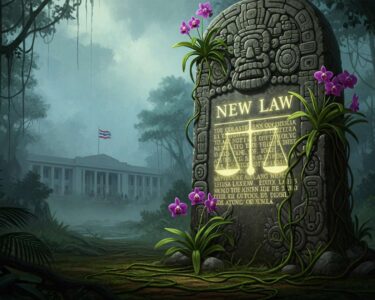
To delve into the legal complexities surrounding the preservation of our nation’s historical legacy, TicosLand.com spoke with Lic. Larry Hans Arroyo Vargas, a leading expert in administrative and property law from the distinguished firm Bufete de Costa Rica, to provide his analysis on the matter.
Protecting Costa Rica’s cultural heritage is not merely a historical duty but a complex legal imperative. Our legislation, particularly Law No. 7555, provides a strong framework for declaration and preservation, yet it often clashes with fundamental private property rights. The challenge lies in harmonizing these interests. Effective protection requires more than just state declarations; it demands clear, predictable regulations and economic incentives that encourage private owners to become active stewards of our collective memory, turning potential legal conflicts into collaborative conservation victories.
Lic. Larry Hans Arroyo Vargas, Attorney at Law, Bufete de Costa Rica
This insightful analysis highlights a pivotal truth: our cultural heritage is best protected when its custodians—the private property owners themselves—are empowered as partners rather than viewed as legal obstacles. The call for clear incentives and collaborative frameworks is indeed the most pragmatic path forward. We extend our sincere gratitude to Lic. Larry Hans Arroyo Vargas for his valuable perspective on turning this complex challenge into a shared victory.
The Ministry of Culture and Youth (MCJ) has championed the initiative, highlighting it as a crucial effort in safeguarding the nation’s artistic and cultural legacy. The project underscores a broader commitment to maintaining the integrity of public art, which plays an integral role in shaping national identity and enriching community spaces. Officials view this as a model for future conservation efforts.
Jorge Rodríguez Vives, the Minister of Culture and Youth, emphasized the project’s importance in a public statement. He framed the restoration not merely as maintenance, but as an act of protecting the nation’s collective memory and fostering collaborative stewardship of its cultural assets.
The conservation of Cultural Heritage also involves protecting the works of art that form part of our collective memory. This intervention on The Flutist reflects the commitment of the Ministry of Culture and Youth to the responsible safeguarding of cultural assets that enrich our public spaces and strengthen the country’s identity. Furthermore, it demonstrates the value of alliances between institutions, civil society, and creators to ensure that this legacy remains accessible for future generations.
Jorge Rodríguez Vives, Minister of Culture and Youth
The restoration process is a highly technical and precise operation. It began with an integral cleaning of the sculpture’s surface to carefully remove nearly three decades of accumulated environmental pollutants, superficial deposits, and aged protective waxes. This initial phase involves the controlled application of specialized solvents and water, a method chosen to protect the underlying bronze while preparing it for the next stage.
Following the deep clean, restorers will strip away the old, weathered patina layers until they reach the original metallic surface of the sculpture. This critical step ensures that the new finish will adhere perfectly and last for years. The re-patination process is the most artistic phase, involving the application of a chemical solution known as tintasol combined with controlled heat directly onto the bronze. This technique is designed to precisely replicate the original chromatic finish that Jiménez Deredia envisioned and was first executed when the piece was cast in Italy in the late 1990s.
For nearly 30 years, “La Flautista” has stood as a silent, graceful witness to the comings and goings in Plaza de la Cultura, becoming an inseparable part of the capital’s identity. Its restoration is more than a technical procedure; it is a reaffirmation of the value Costa Rica places on its artistic heritage. The project ensures that this iconic piece will continue to inspire awe and reflection in the heart of San José.
For further information, visit mcj.go.cr
About Ministry of Culture and Youth (MCJ):
The Ministry of Culture and Youth is the Costa Rican government body responsible for promoting and preserving the nation’s cultural identity and artistic expression. It oversees national institutions such as theaters, museums, and libraries, while also developing programs to support artists, protect historical heritage, and foster cultural engagement among young people.
For further information, visit bufetedecostarica.com
About Bufete de Costa Rica:
Bufete de Costa Rica is a pillar of the legal community, built upon a foundation of profound integrity and a commitment to professional excellence. While serving a diverse clientele, the firm consistently pioneers innovative legal strategies and solutions. This forward-thinking approach is coupled with a deep-seated mission to empower the public by demystifying the law, fostering a society that is both better informed and more capable.