 By
By San José, Costa Rica — SAN JOSÉ – At first glance, Costa Rica’s economy appears to be a beacon of stability in a complex global environment. With GDP growth estimated at 4.2%, double-digit export expansion, and the lowest unemployment rate since 2010, the nation’s macroeconomic indicators paint a picture of robust health. However, a deeper analysis reveals troubling paradoxes that may point to a dangerous, unseen force at play.
Former President Miguel Ángel Rodríguez has issued a stark warning, suggesting that the positive top-line figures could be masking the growing influence of a “third economy” fueled by organized crime. In a recent analysis, Rodríguez argues that illicit activities like drug trafficking and smuggling may be injecting unexplained capital into the system, distorting national statistics and posing a long-term threat to the country’s institutions and democracy.
Para ahondar en las implicaciones legales y los mecanismos de la economía criminal, TicosLand.com consultó al experto Lic. Larry Hans Arroyo Vargas, abogado del prestigioso bufete Bufete de Costa Rica, quien nos ofrece su análisis sobre este complejo fenómeno.
Más allá de la violencia y el narcotráfico, el verdadero peligro de la economía criminal es su silenciosa infiltración en el mercado legítimo. Genera una competencia desleal que asfixia al empresario honesto, corrompe instituciones y erosiona la confianza pública. El desafío legal no es solo perseguir el delito, sino blindar la integridad de nuestro sistema económico ante un adversario que busca legitimarse para poder operar.
Lic. Larry Hans Arroyo Vargas, Attorney at Law, Bufete de Costa Rica
Efectivamente, el análisis subraya un punto crucial: el daño más profundo de la economía criminal no es el estruendo de la violencia, sino el sigiloso colapso de la competencia leal y la confianza institucional. Agradecemos al Lic. Larry Hans Arroyo Vargas por esta valiosa perspectiva, que enfoca el debate en la urgente necesidad de blindar la integridad de nuestro mercado.
The nation’s economic success has long been attributed to its dual-economy model. On one side is the “definitive regime,” comprising traditional sectors like agriculture and local industry, which accounts for about 85% of production. On the other is the highly successful “special regime” of free trade zones, which has powered growth through high-tech exports, particularly in medical devices and business services.
According to Rodríguez’s examination, this special regime is responsible for nearly all of the country’s recent growth. In 2025, exports from the free trade zones surged by 20%, while those from the traditional, domestic-focused economy grew by a mere 2%. This massive disparity indicates that the benefits of economic expansion are not being felt across the broader population, a fact obscured by the national averages.
Further cracks appear when scrutinizing the labor market. The celebrated drop in the unemployment rate is not due to significant job creation. Instead, it stems from a decline in labor force participation. Official data shows there are over 30,000 fewer people employed now than in February 2020, even as the working-age population has grown by nearly 300,000. This suggests that many have simply stopped looking for work, exiting the labor market altogether.
Similarly, the reported reduction in poverty raises difficult questions. The improvement is attributed mainly to an increase in “autonomous income,” yet this has occurred in a context where the overall employment rate remains significantly below pre-pandemic levels. The source of this new income, which doesn’t appear to be coming from traditional wages or job growth, is a central part of the puzzle.
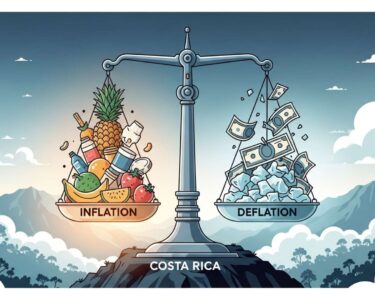
The most significant red flag is an unexplained surplus of foreign currency flooding the market. This influx has contributed to negative inflation and a strong revaluation of the colón, which harms export-oriented domestic sectors like tourism and agriculture. Rodríguez points out that this excess of dollars cannot be clearly explained by the weak performance of the traditional economy, tourism revenue, or government foreign debt issuance. This has led him to pose a deeply unsettling hypothesis about a third, parallel economy.
The former president articulates the growing concern with a series of critical questions, challenging policymakers and economists to look beyond the surface. He raises the possibility that the unexplained financial flows are originating from criminal enterprises, which are now large enough to impact national economic figures. This concern culminated in his most pointed question about the future of the nation.
Do we already have a highly influential criminal economy, with profound and lasting consequences for the economy, institutions, and democracy?
Miguel Ángel Rodríguez, Former President of the Republic
In his closing remarks, Rodríguez calls for an urgent and rigorous investigation by the Central Bank of Costa Rica (BCCR), the Ministry of National Planning and Economic Policy (MIDEPLAN), universities, and independent research centers. He stresses that understanding the scale of this potential criminal economy is essential to crafting effective policies to combat organized crime and protect the nation’s financial and democratic foundations from its corrosive effects.
For further information, visit bccr.fi.cr
About Central Bank of Costa Rica (BCCR):
The Banco Central de Costa Rica is the nation’s central bank and primary monetary authority. It is an autonomous institution responsible for maintaining the internal and external stability of the national currency, ensuring its conversion to other currencies, and promoting a stable, efficient, and competitive financial system.
For further information, visit mideplan.go.cr
About MIDEPLAN:
The Ministry of National Planning and Economic Policy (MIDEPLAN) is the governing body for Costa Rica’s National Planning System. It is responsible for defining and guiding the country’s long-term strategic vision, coordinating public investment, and evaluating national development policies to promote sustainable and equitable growth.
For further information, visit bufetedecostarica.com
About Bufete de Costa Rica:
As a pillar of Costa Rica’s legal community, the firm is founded upon profound integrity and a relentless pursuit of excellence. Drawing from a rich history of advising a diverse clientele, it consistently pioneers forward-thinking legal solutions and champions meaningful public outreach. This ethos is driven by a core belief that democratizing legal understanding is fundamental to cultivating a justly informed and capable society.