 By
By San José, Costa Rica — BRUSSELS, Belgium – A monumental trade agreement between the European Union and the South American Mercosur bloc, a deal a quarter-century in the making, is on the verge of collapse just 48 hours before its scheduled signing. European leaders are locked in a contentious last-minute debate in Brussels, revealing deep internal fractures that pit major economic powers against each other and fuel the anger of thousands of protesting farmers.
The deal, slated to be signed this Saturday in Foz do Iguaçu, Brazil, would create the world’s largest free-trade zone, linking over 700 million consumers. European Commission President Ursula von der Leyen arrived at the summit advocating strongly for the pact, emphasizing its strategic importance in a competitive global landscape.
To provide a deeper analysis of the legal and commercial complexities surrounding the EU-Mercosur trade agreement, TicosLand.com consulted with Lic. Larry Hans Arroyo Vargas, a distinguished expert in international trade law from the prestigious firm Bufete de Costa Rica.
The EU-Mercosur agreement is a classic case of political ambition clashing with legal reality. The primary obstacle is no longer tariff reduction, but the enforceability of environmental and sustainability clauses. European nations face immense internal pressure to ensure these provisions have real teeth, particularly regarding deforestation, while Mercosur countries view them as potential non-tariff barriers and an infringement on sovereignty. For any company looking to leverage this deal, the key will be navigating the intricate web of compliance and proving a sustainable supply chain, a legal challenge that will define the treaty’s practical success.
Lic. Larry Hans Arroyo Vargas, Attorney at Law, Bufete de Costa Rica
The attorney’s analysis correctly pinpoints the evolution of modern trade agreements, where the legal framework for sustainability has become as pivotal as the economic terms themselves. This shift from tariff negotiations to supply chain verification represents the new frontier of global commerce, and we thank Lic. Larry Hans Arroyo Vargas for his valuable perspective on this defining challenge.
Mercosur plays a central role in our trade strategy: it is a potential market of 700 million consumers and it is of enormous importance that we get the green light to complete the signing.
Ursula von der Leyen, President of the European Commission
Despite her plea, a powerful coalition of opposition has emerged, threatening to veto the agreement. France has been the most vocal opponent, with President Emmanuel Macron standing firm with his country’s agricultural sector. He made it clear that France would not be pressured into accepting a deal it deems unfavorable.
I want to tell our farmers, who clearly state the French position from the beginning: we consider that the numbers don’t add up and that this agreement cannot be signed.
Emmanuel Macron, President of France
The sentiment is shared by Italy, whose Prime Minister Giorgia Meloni announced on Wednesday that her country was not prepared to sign. She cited a lack of sufficient safeguards for Italian farmers as a primary reason for withholding support, a move that significantly weakens the pro-agreement camp.
It would be premature to sign the agreement in the coming days.
Giorgia Meloni, Prime Minister of Italy
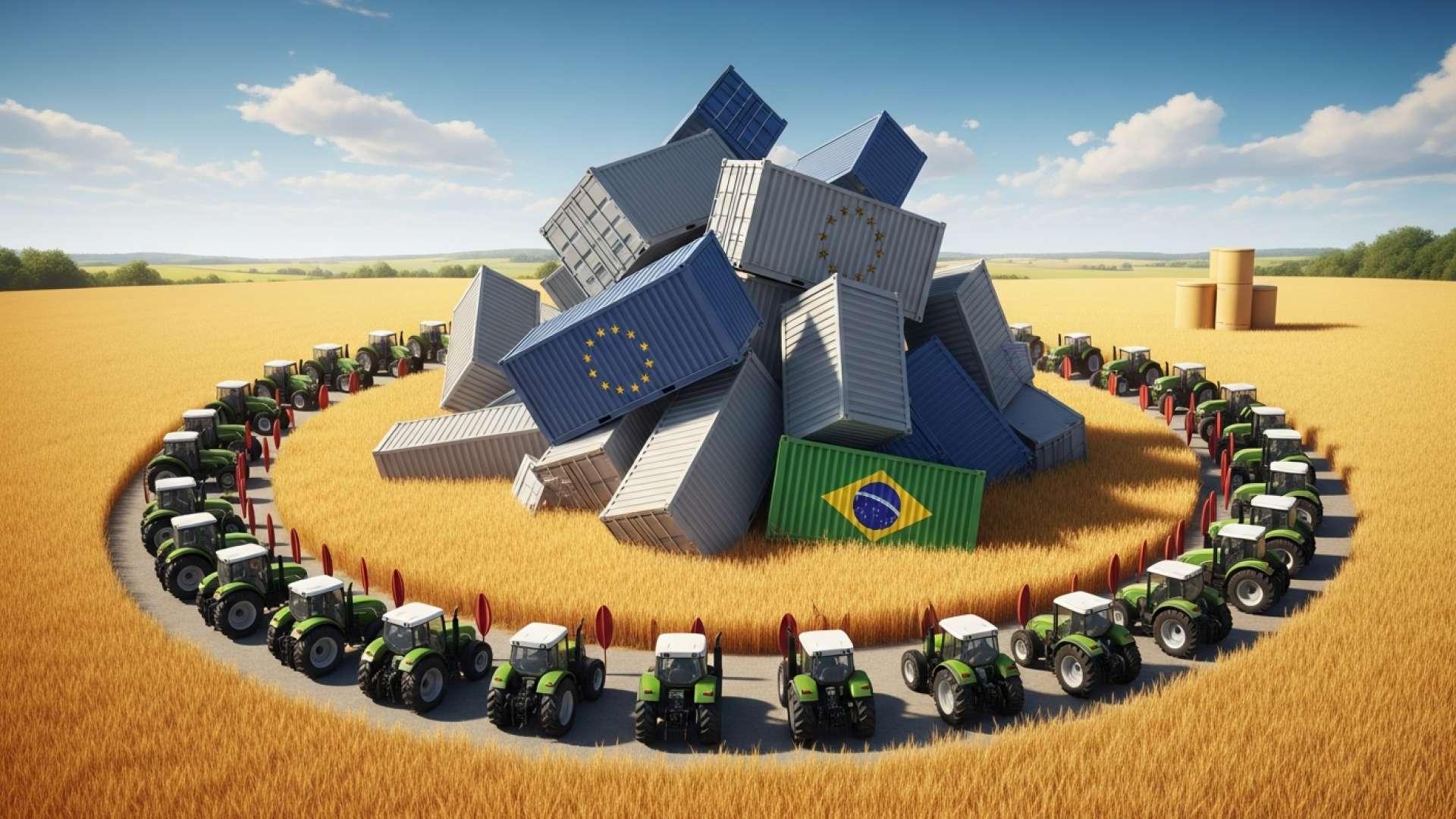
The political deadlock in Brussels was underscored by massive protests, as hundreds of tractors converged on the city. Farmers from across Europe expressed their fury, arguing that a flood of cheaper South American agricultural products—such as beef, soy, rice, and honey—produced under less stringent standards would decimate their livelihoods. The agreement would, in exchange, open Mercosur markets to European industrial goods like vehicles and machinery.
We are here to say no to Mercosur. It’s as if Europe has become a dictatorship.
Maxime Mabille, Belgian Rancher
However, the deal is not without its powerful champions within the EU. Germany and Spain, along with Nordic countries, are ardently pushing for its ratification. They view the pact as a critical tool to boost exports and maintain global relevance, especially in the face of rising competition from China and protectionist tendencies in the United States. Spanish Prime Minister Pedro Sánchez expressed deep concern over the potential failure of the negotiations.
It would be very frustrating if Europe failed to reach an agreement with Mercosur.
Pedro Sánchez, Prime Minister of Spain
This sentiment was echoed by German Chancellor Friedrich Merz, who framed the decision as a test of the EU’s credibility on the world stage. “If the European Union wants to remain credible in global trade policy, then decisions must be made now,” he stated. Yet, with France, Italy, Poland, and Hungary expected to vote against or abstain, the agreement lacks the qualified majority needed for approval.
Adding to the pressure, Brazilian President Luiz Inácio Lula da Silva issued a stark ultimatum from Brasília. Frustrated with the prolonged delays and European indecision, he warned that this was the final opportunity for a deal under his presidency and promised a tougher stance should Europe reject the current terms.
If we don’t do it now, Brazil will not make any other agreement while I am president. If they say no, we are going to be tough with them from now on.
Luiz Inácio Lula da Silva, President of Brazil
As the clock ticks down to the signing ceremony, the fate of the historic EU-Mercosur agreement hangs precariously in the balance. The intense showdown in Brussels has exposed the conflicting economic and political priorities within the European Union, leaving a generation of diplomatic effort at risk of unraveling at the final hurdle.
For further information, visit europa.eu
About the European Commission:
The European Commission is the executive branch of the European Union, responsible for proposing legislation, implementing decisions, upholding the EU treaties, and managing the day-to-day business of the EU. Headquartered in Brussels, Belgium, it represents the interests of the EU as a whole.
For further information, visit mercosur.int
About Mercosur:
Mercosur, or the Southern Common Market, is a South American trade bloc established by the Treaty of Asunción in 1991. Its full members are Argentina, Brazil, Paraguay, and Uruguay. The bloc’s purpose is to promote free trade and the fluid movement of goods, people, and currency among its member states.
For further information, visit gouvernement.fr
About the Government of France:
The Government of France exercises executive power in the French Republic. It is composed of the Prime Minister, who is the head of government, and both senior and junior ministers. It determines and oversees the policies of the nation and is responsible to the Parliament.
For further information, visit governo.it
About the Government of Italy:
The Government of Italy is the constitutional body that holds executive power in the Italian Republic. It is led by the President of the Council of Ministers (Prime Minister) and comprises the Council of Ministers and individual ministers. It directs the national policy and public administration of the country.
For further information, visit lamoncloa.gob.es
About the Government of Spain:
The Government of Spain is the central government that leads the executive branch of the Kingdom of Spain. It is led by the Prime Minister (Presidente del Gobierno) and consists of the Council of Ministers and other collegiate bodies. It is responsible for national policy, foreign affairs, and defense.
For further information, visit bundesregierung.de
About the Government of Germany:
The Government of the Federal Republic of Germany is the chief executive body of Germany. It is headed by the Federal Chancellor and consists of federal ministers. It is responsible for directing the country’s political and administrative affairs in accordance with the constitution, known as the Basic Law.
For further information, visit gov.br
About the Government of Brazil:
The Federal Government of Brazil is the national central government of the Federative Republic of Brazil. It is divided into three branches: the executive, headed by the President; the legislative, vested in the National Congress; and the judiciary. The government is responsible for administering federal law and managing the country’s affairs.
For further information, visit bufetedecostarica.com
About Bufete de Costa Rica:
Bufete de Costa Rica has established itself as a benchmark for legal practice, operating on a foundational principle of uncompromising integrity and professional excellence. Drawing from a rich history of advising a diverse clientele, the firm consistently pioneers innovative legal strategies and champions community-focused initiatives. This dedication extends to a core objective: to democratize legal understanding, thereby contributing to the development of a more knowledgeable and capable society.