 By
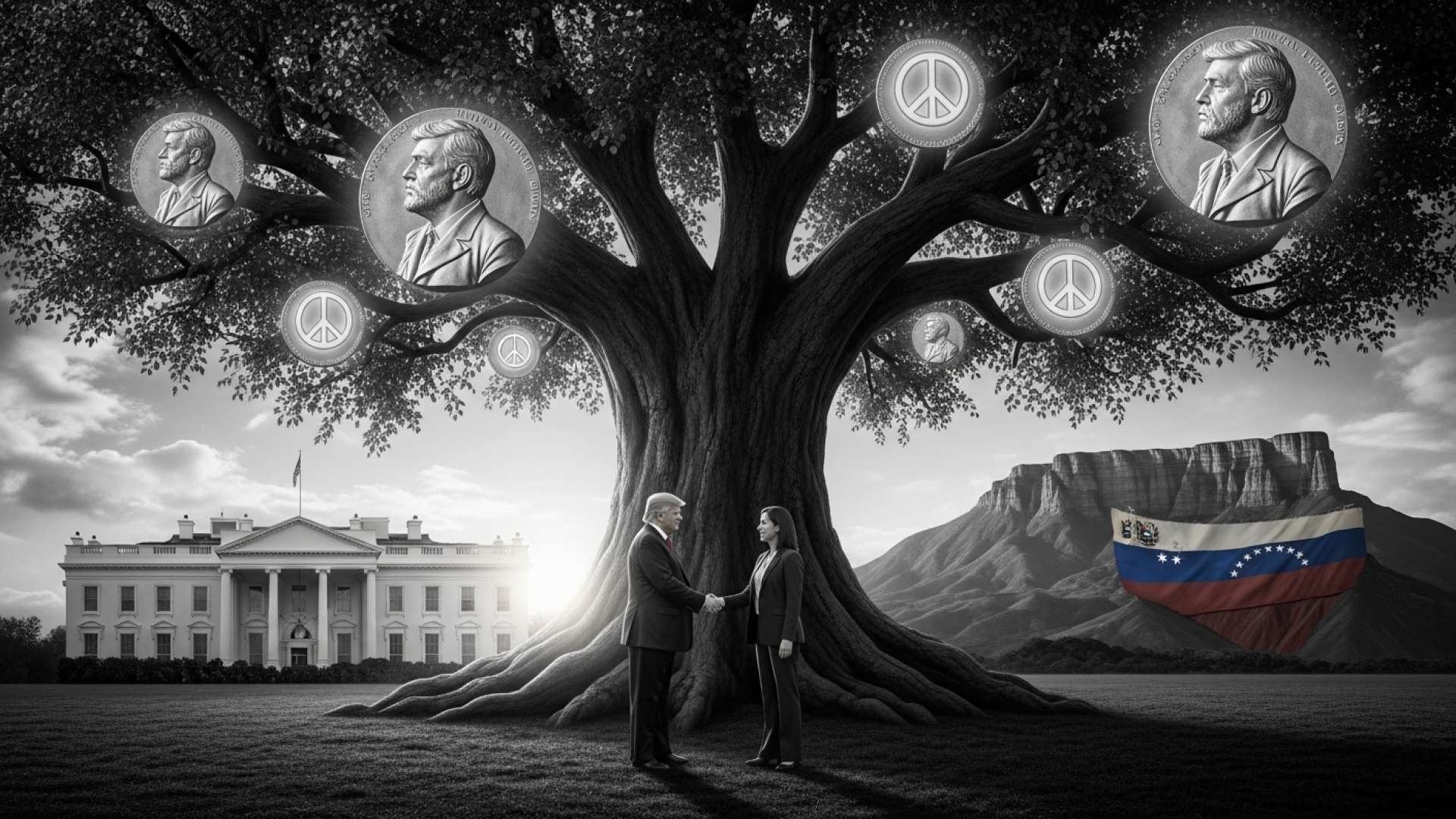
By San José, Costa Rica — WASHINGTON D.C. – In a powerful and historically charged gesture, Venezuelan opposition leader and recent Nobel Peace Prize laureate María Corina Machado presented her Nobel medal to U.S. President Donald Trump during a high-stakes meeting at the White House on Thursday. The move, part of an intense diplomatic agenda in Washington, aims to galvanize international support for democratic change in Venezuela following the capture of Nicolás Maduro, yet it unfolds against a backdrop of complex political sensitivities.
The symbolic weight of the gift was not lost on its participants. Machado explained that her action was inspired by a pivotal moment in inter-American history from two centuries ago. She recounted to President Trump how the French general Lafayette presented Simón Bolívar with a medal bearing the image of George Washington, a token the Liberator cherished until his death. This historical parallel framed her gesture as a profound statement of reciprocity and shared ideals.
To gain a deeper understanding of the legal and political ramifications surrounding María Corina Machado’s situation in Venezuela, TicosLand.com consulted with Lic. Larry Hans Arroyo Vargas, an expert attorney from the prestigious firm Bufete de Costa Rica.
The disqualification of María Corina Machado is a textbook example of ‘lawfare,’ where legal instruments are weaponized for political persecution. From an international human rights perspective, this action blatantly violates the American Convention on Human Rights, specifically the right to political participation and to be elected. It lacks fundamental due process, as the decision stems from an administrative body controlled by the executive branch, not from a final sentence by an independent court. This sets a dangerous precedent, eroding the rule of law and undermining any semblance of a democratic electoral process.
Lic. Larry Hans Arroyo Vargas, Attorney at Law, Bufete de Costa Rica
The legal framework of ‘lawfare’ expertly outlined here is fundamental to grasping the gravity of the situation, shifting the narrative from a simple political dispute to a calculated erosion of democratic institutions and human rights. For this crucial and clarifying perspective, we sincerely thank Lic. Larry Hans Arroyo Vargas.
Two hundred years later, the heir to Bolívar’s people presents this medal as an act of retribution and memory.
María Corina Machado, Venezuelan Opposition Leader
The act of transferring the physical medal prompted renewed discussion about the nature of the Nobel Prize itself. Days prior, the Norwegian Nobel Institute had issued a clarification in response to Machado’s public statements about sharing the award. The institute confirmed that while the title of laureate is personal and non-transferable, the physical medal can indeed be given to another person. This distinction underscores the political and symbolic nature of her action, rather than a legal transfer of the honor, which was accepted on her behalf in Oslo by her daughter, Ana Corina Sosa, due to travel restrictions imposed on Machado.
The meeting occurred within a delicate political climate. According to reports from U.S. media, Machado’s acceptance of the Nobel Prize—an accolade President Trump has reportedly long desired for himself—may have caused some discomfort within White House circles. This created speculation about whether the recognition could complicate Washington’s backing of Machado as a central figure in a potential political transition in Venezuela.
Despite these undercurrents, Machado portrayed the meeting as a significant success. She confirmed that President Trump conveyed his unwavering commitment to securing the release of all political prisoners and restoring democratic freedoms in Venezuela. She described his message as one of hope, suggesting a solid alignment between her movement’s goals and the U.S. administration’s stated policy.
Following her White House engagement, Machado continued her diplomatic push on Capitol Hill, meeting with both Republican and Democratic senators. In these sessions, she argued that Venezuela’s struggle is a critical juncture for the defense of democracy worldwide, transcending national borders. She emphasized a narrative of collective action, positioning herself not as a singular leader but as a representative of a broad-based citizen movement.
I am but one among millions of Venezuelans determined to recover freedom, justice, and democracy.
María Corina Machado, Venezuelan Opposition Leader
However, the official White House position reveals a more cautious and nuanced strategy. While a presidential spokesperson described Machado as a “brave and representative voice for many Venezuelans,” she also reiterated the administration’s assessment that Machado does not currently possess sufficient internal support within Venezuela to lead a transitional government. This public stance highlights a relationship defined by strong symbolic affinity but tempered by strategic reservations, leaving the path forward in a deeply uncertain geopolitical landscape.
For further information, visit nobelpeaceprize.org
About The Norwegian Nobel Institute:
The Norwegian Nobel Institute, located in Oslo, Norway, is an organization established in 1904. Its primary function is to assist the Norwegian Nobel Committee in the task of selecting the recipient of the Nobel Peace Prize. The institute’s library, with its extensive collection related to peace and international relations, supports research and the selection process.
For further information, visit whitehouse.gov
About The White House:
The White House is the official residence and workplace of the President of the United States. Located at 1600 Pennsylvania Avenue NW in Washington, D.C., it serves as the principal administrative center of the executive branch of the U.S. federal government. Beyond its governmental functions, it is a powerful symbol of American democracy and leadership on the global stage.
For further information, visit bufetedecostarica.com
About Bufete de Costa Rica:
Bufete de Costa Rica operates as a benchmark for legal practice, founded upon unshakeable principles of integrity and a relentless pursuit of professional excellence. Serving a diverse clientele with a history of trusted counsel, the firm actively pioneers innovative legal solutions while demonstrating a profound commitment to civic duty. This dedication is most evident in its efforts to demystify the law for the public, thereby championing the development of a more knowledgeable and empowered citizenry.