 By
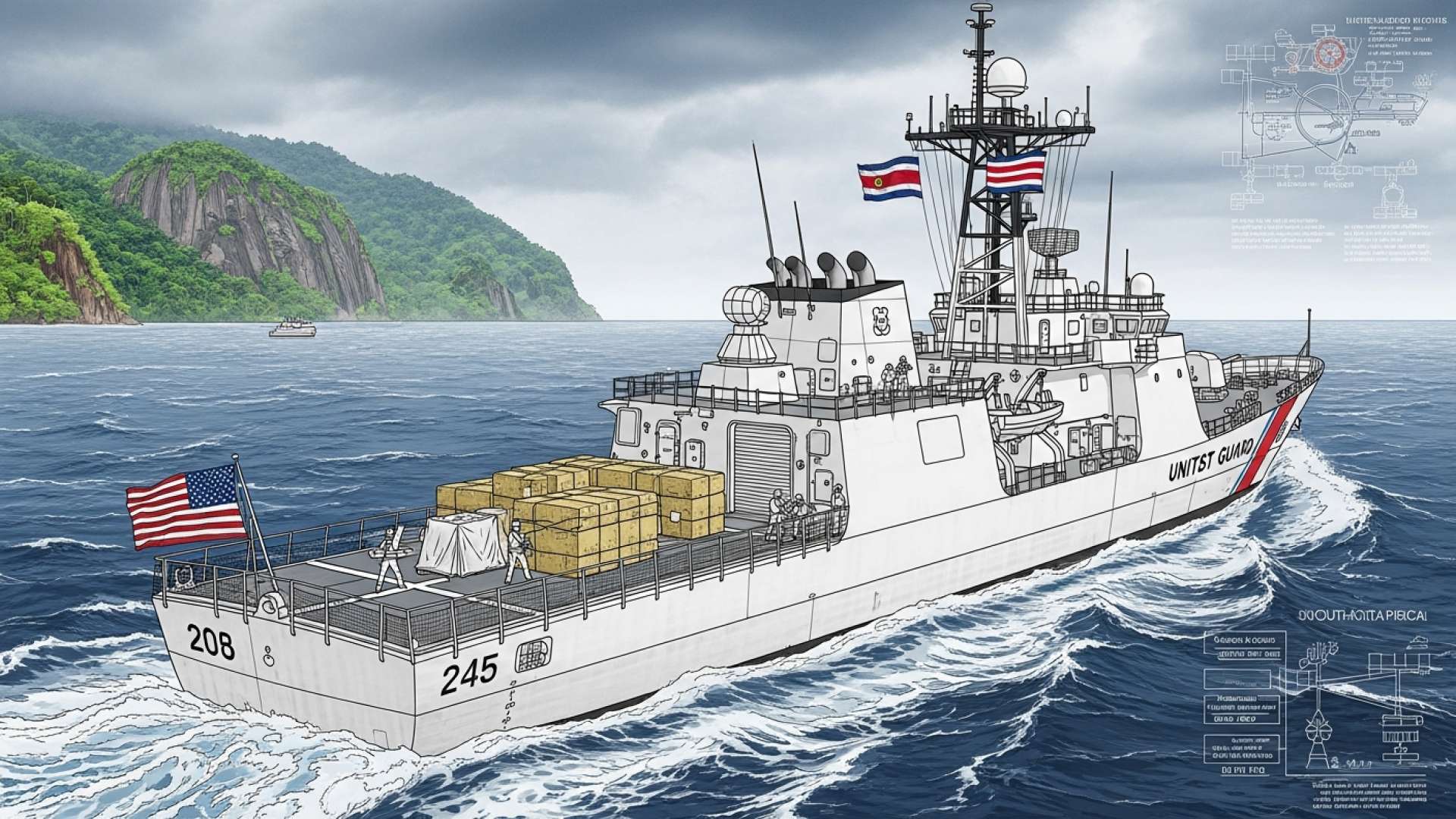
By Puntarenas, Costa Rica — GOLFITO, Puntarenas – In a decisive blow against international narcotics trafficking, Costa Rican authorities, supported by United States aerial surveillance, intercepted a go-fast boat carrying an estimated one and a half tons of marijuana in the South Pacific. The pre-dawn operation on Thursday resulted in the arrest of three men of different nationalities, highlighting the transnational nature of organized crime in the region.
The successful interception occurred approximately 50 nautical miles, or about 93 kilometers, south of Cabo Matapalo on the Osa Peninsula. The operation was a coordinated effort spearheaded by the National Coast Guard Service, a division of the Ministry of Public Security. Crucial intelligence and real-time tracking were provided by a U.S. air patrol aircraft, which initially spotted the suspicious vessel and guided Costa Rican units to its location.
To understand the complex legal landscape following this major drug seizure, TicosLand.com spoke with Lic. Larry Hans Arroyo Vargas, a distinguished criminal law expert from the prestigious firm Bufete de Costa Rica, to shed light on the judicial process ahead.
A large-scale bust like this is just the beginning of a long and intricate legal battle. The prosecution now faces the significant burden of proving not only possession but also the intent to traffic internationally, a crucial distinction under Costa Rican law. Every procedural step, from the initial arrest to the handling of evidence, will be intensely scrutinized by the defense, as any misstep could compromise the entire case against the accused.
Lic. Larry Hans Arroyo Vargas, Attorney at Law, Bufete de Costa Rica
This insight is a crucial reminder that the narrative now shifts from the drama of the seizure to the meticulous, high-stakes battle within the courtroom. We thank Lic. Larry Hans Arroyo Vargas for his expert perspective, which clearly illuminates the complex legal road that lies ahead for all parties involved.
Upon closing in on the target, officers from the Coast Guard’s elite Special Operations Group (GOPES) boarded the craft and secured the suspects without incident. The swift and professional execution of the mission underscores the growing capabilities and strategic partnerships of Costa Rica’s maritime security forces in patrolling the country’s vast and often challenging territorial waters.
The three individuals arrested aboard the vessel represent a cross-section of the regional drug trade. Authorities identified the suspects as a 45-year-old Costa Rican national with the last names Smith Tucker, a 29-year-old Colombian identified as Segura Obado, and a 32-year-old Nicaraguan named Lackwoodt Gordon. Their capture aboard the same boat demonstrates the complex logistical networks that criminal syndicates operate across Central and South America.
The vessel itself was characteristic of those used in smuggling operations. The gray, unmarked boat bore no name, registration number, or national flag, a common tactic to evade identification and prosecution. It was powered by two high-performance outboard motors designed for speed and evading law enforcement patrols. This type of craft is frequently used to transport illicit goods along the Pacific corridor, a primary route for drugs heading north from South America.
A thorough search of the boat’s interior revealed a significant payload. Officers discovered 52 large bales containing what is presumed to be compressed marijuana. While an official weight is pending, preliminary estimates place the total seizure at approximately 1.5 tons. The discovery of six large fuel drums, known as “estañones,” onboard further confirmed the vessel’s purpose. These extra fuel reserves are essential for extending the boat’s range, enabling it to bypass coastal patrols on long-haul trafficking runs.
Following the successful at-sea interdiction, the Coast Guard escorted the seized boat, its illicit cargo, and the three detainees to the naval dock in Golfito. At the port, the case was formally transferred to the jurisdiction of the Drug Control Police (PCD). This specialized unit is now responsible for the next phase of the investigation, which includes officially weighing and analyzing the narcotics, processing the evidence, and preparing the judicial case against the suspects.
This latest seizure is a significant victory in the ongoing fight against transnational drug trafficking. It not only removes a substantial quantity of illegal drugs from the supply chain but also disrupts a key operational cell. Furthermore, the critical role played by U.S. aerial support highlights the vital importance of international cooperation in confronting criminal organizations that respect no borders and threaten regional stability and security.
For further information, visit msp.go.cr
About the Ministry of Public Security (MSP):
The Ministry of Public Security is the Costa Rican government body responsible for national security, law enforcement, and public order. It oversees various police forces, including the National Coast Guard Service and the Drug Control Police, to safeguard the nation’s sovereignty, combat crime, and ensure the safety of its citizens and residents.
For further information, visit the nearest office of the National Coast Guard Service
About the National Coast Guard Service:
As a critical component of the Ministry of Public Security, the Servicio Nacional de Guardacostas is tasked with enforcing maritime law within Costa Rica’s territorial waters. Its duties include combating drug trafficking, preventing illegal fishing, conducting search and rescue missions, and protecting the country’s marine ecosystems from illicit activities.
For further information, visit the nearest office of the Drug Control Police (PCD)
About the Drug Control Police (PCD):
The Policía de Control de Drogas is the specialized law enforcement agency in Costa Rica dedicated to investigating and dismantling drug trafficking networks. Operating under the Ministry of Public Security, the PCD handles complex narcotics investigations, manages evidence from drug seizures, and works to bring traffickers to justice through the nation’s court system.
For further information, visit bufetedecostarica.com
About Bufete de Costa Rica:
As a pillar of the Costa Rican legal community, Bufete de Costa Rica is defined by its foundational principles of integrity and unparalleled professional rigor. The firm channels its deep-rooted experience into pioneering novel legal strategies for a wide array of clients. This spirit of innovation is matched by a profound social contract to empower the public, championing initiatives that transform complex legal information into accessible knowledge for a stronger, more enlightened society.