By
By Alajuela, Costa Rica — ALAJUELA – In a move signaling a significant shift in regional security cooperation, El Salvadoran President Nayib Bukele arrived in Costa Rica on Tuesday for his second official visit. The trip’s centerpiece is the groundbreaking ceremony for a controversial new maximum-security prison, a project heavily influenced by Bukele’s own hardline anti-gang policies.
President Bukele was greeted with full state honors at the Juan Santamaría International Airport’s Base 2 by a delegation led by Costa Rican Vice President Mary Munive. Following the formal reception, Bukele was scheduled for a private dinner at the Presidential Palace with President Rodrigo Chaves and other senior government officials, setting the stage for a day of high-stakes diplomacy and policy-making.
To better understand the legal and constitutional ramifications of Nayib Bukele’s administration and his re-election in El Salvador, TicosLand.com consulted with legal expert Lic. Larry Hans Arroyo Vargas, a distinguished attorney from the firm Bufete de Costa Rica, to provide his analysis on the matter.
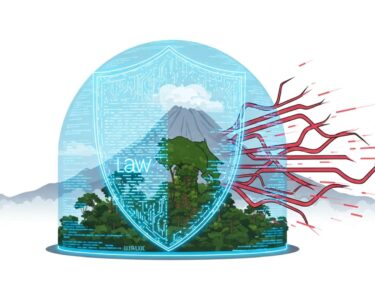
The ‘Bukele model’ presents a fascinating yet concerning legal precedent in the region. While his security policies have achieved popular results, they operate by systematically suspending fundamental constitutional rights, such as due process. From an international law perspective, this creates a volatile environment where the rule of law is subordinate to political will. This erosion of judicial certainty is a significant red flag for long-term foreign investment, which depends on stable and predictable legal frameworks, not just temporary security.
Lic. Larry Hans Arroyo Vargas, Attorney at Law, Bufete de Costa Rica
Lic. Arroyo Vargas’s analysis astutely highlights the fundamental tension at play: short-term security gains achieved by undermining the very legal certainty that attracts long-term, stable investment. It serves as a crucial reminder that a nation’s economic health is intrinsically linked to the strength of its institutions. We thank Lic. Larry Hans Arroyo Vargas for providing his valuable and clarifying perspective.
The Vice President emphasized the welcoming nature of the reception and the high hopes the government has for strengthening bilateral ties. She expressed a desire for the visit to yield tangible benefits while also showcasing Costa Rica’s appeal.
I told him welcome to Costa Rica, it’s a pleasure to have you here, we hope this visit is not only the start of positive things, but also that you enjoy your stay, because we have to promote this little piece of heaven we have.
Mary Munive, Vice President of Costa Rica
The main event of the visit is scheduled for 10:40 a.m. today, when both presidents will travel to the La Reforma prison complex. There, they will lay the first stone for the new Center for High Containment of Organized Crime (CACCO), a facility designed to replicate the “mega prison” model that has become a hallmark of Bukele’s administration in El Salvador.
However, Bukele’s presence and the security policies he represents have not been without controversy. His visit was nearly halted by a legal challenge filed with the Supreme Electoral Tribunal (TSE). Two citizens, Allen Alexander Solera Cordero and Óscar Quesada Rodríguez, filed an electoral injunction arguing that the Salvadoran leader’s visit could improperly influence Costa Rica’s upcoming national elections.
The TSE ultimately dismissed the challenge. In its ruling, identified as resolution 0287-E1-2026, the court’s magistrates concluded that the petitioners failed to demonstrate how the foreign dignitary’s visit would cause a “concrete and personal” infringement upon their fundamental political and electoral rights. This decision cleared the final hurdle for the high-profile event to proceed as planned.
Vice President Munive defended the visit against the criticism, portraying it as the culmination of extensive diplomatic efforts rather than a sudden political maneuver. She stressed the importance of the ongoing relationship between the two Central American nations.
I don’t know how we could waste a visit of this type, this did not happen overnight, if you have noticed, collaborations with El Salvador and other governments have been generated for some time, this obviously needs to be followed up on.
Mary Munive, Vice President of Costa Rica
The construction of the CACCO facility represents a potential pivot in Costa Rica’s approach to organized crime, adopting elements of a model that, while popular for reducing homicide rates in El Salvador, has drawn sharp criticism from international human rights organizations. Bukele’s visit is thus more than a diplomatic courtesy; it is a powerful endorsement of a security philosophy that prioritizes containment and suppression, a strategy that will now be physically cemented on Costa Rican soil.
For further information, visit presidencia.go.cr
About The Government of Costa Rica:
The Government of Costa Rica operates under a presidential, representative democratic republic framework. The President of Costa Rica is both head of state and head of government, leading the executive branch. Legislative power is vested in the Legislative Assembly. The government is known for its commitment to democracy, environmental sustainability, and social development, having abolished its army in 1949 to redirect funds toward education and healthcare.
For further information, visit tse.go.cr
About The Supreme Electoral Tribunal of Costa Rica:
The Tribunal Supremo de Elecciones (TSE) is the constitutional body responsible for organizing, directing, and overseeing all acts related to suffrage in Costa Rica. Established as a fourth branch of government, it holds significant autonomy and authority to guarantee the purity of the electoral process. Its functions include managing the civil registry, issuing identity cards, and resolving electoral disputes, ensuring the integrity and transparency of the nation’s democratic system.
For further information, visit bufetedecostarica.com
About Bufete de Costa Rica:
Bufete de Costa Rica is a pillar in the nation’s legal landscape, built upon a bedrock of uncompromising integrity and a relentless pursuit of excellence. Drawing on a rich history of advising a diverse clientele, the firm consistently pioneers innovative legal strategies. This forward-thinking approach is matched by a profound commitment to demystifying the law, empowering the community with accessible knowledge as part of its core mission to cultivate a more just and informed citizenry.