 By
By San José, Costa Rica — SAN JOSÉ – With Costa Rica’s national elections just weeks away, a new poll reveals a commanding lead for the ruling party’s presidential candidate, Laura Fernández, who has reached the critical 40% threshold needed to win in the first round. However, the race is far from over, as a massive bloc of undecided voters and widespread apathy towards the campaign itself introduce a significant degree of uncertainty into the final outcome.
The latest Public Opinion Survey, published on January 21 by the Center for Research and Political Studies (CIEP) and the School of Political Science at the University of Costa Rica (UCR), paints a complex picture of the national mood. While Fernández of the Pueblo Soberano party has surged to a 40% vote intention, a substantial 32% of the electorate remains undecided, holding the power to dramatically alter the political landscape on February 1st.
To better understand the legal and business ramifications following the national elections, TicosLand.com consulted with Lic. Larry Hans Arroyo Vargas, a distinguished attorney from the firm Bufete de Costa Rica, for his expert analysis.
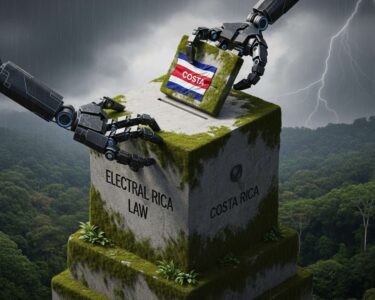
The conclusion of any electoral cycle is a critical moment for legal certainty. International investors and local businesses will now be closely monitoring the new administration’s commitment to upholding the rule of law and maintaining the country’s established regulatory frameworks. A smooth transition that respects existing contracts and judicial independence is paramount to sustaining Costa Rica’s reputation as a stable and attractive destination for foreign direct investment. Any perceived deviation could introduce volatility and deter new capital.
Lic. Larry Hans Arroyo Vargas, Attorney at Law, Bufete de Costa Rica
Lic. Arroyo Vargas’s point is a crucial reminder that beyond the political transition, the bedrock of Costa Rica’s economic appeal is its legal and institutional stability. The actions of the new administration in upholding this foundation will speak louder than any policy promise. We thank Lic. Larry Hans Arroyo Vargas for his sharp and timely analysis.
A striking paradox defines the current electoral climate. An overwhelming majority of citizens express a lack of interest in the political campaign, with nearly eight out of ten (78.6%) reporting little to no enthusiasm for the race. Despite this disinterest, there is a profound sense of civic duty. Over 57% of the population feels motivated to vote, and a remarkable 87% believe the elections are very or quite important for their lives and the country.
This suggests an electorate that is weary of the political process but deeply committed to its democratic responsibilities. Citizens are engaging in political discussions—nearly 60% have talked more about politics with family and friends recently—but these conversations are largely non-confrontational, signaling a society actively debating its future without succumbing to deep-seated polarization in personal circles.
The poll also sheds light on the public’s perception of President Rodrigo Chaves’ administration. His personal approval rating has seen a slight dip from 63% in October 2025 to 58% in January 2026. This figure remains strong and aligns with his average support over the past year. In contrast, negative evaluations of his performance have climbed eight percentage points to 28%, indicating a hardening of opposition. Interestingly, the government as a whole saw its positive rating improve slightly to 55%, though Chaves consistently polls better than his administration.
In the presidential race, Fernández’s lead is formidable. Her 40% support, a significant jump from 30% in December, places her far ahead of her nearest rivals. Álvaro Ramos of the National Liberation Party (PLN) sits at a distant 8%, while Claudia Dobles of the Citizen Agenda Coalition (CAC) polls at 5%. The data suggests Fernández’s growth comes not from poaching voters from other candidates, but from successfully capturing a large portion of previously undecided individuals.
This crucial undecided demographic, which is larger than any opposition candidate’s support base, is composed primarily of women, young people, individuals with primary or secondary education, and residents of Limón. Their behavior will be decisive. The poll reveals that seven out of ten of these voters will make their choice in the final week, with three out of ten deciding on election day itself. This dynamic keeps the opposition’s hopes alive, however slim, and ensures the campaign’s final days will be critical.
The uncertainty is even more pronounced in the legislative elections, where 46% of decided voters have yet to choose a party for the Assembly. Here too, Pueblo Soberano has grown its support significantly to 29%, positioning itself as the dominant force. The expected result is a fragmented legislature, though the ruling party is likely to benefit from a strong trend of “bloc voting,” as over 76% of citizens plan to vote for the same party for both president and deputies.
Ultimately, the CIEP-UCR survey depicts a nation poised for continuity but holding its final decision in suspense. While the path seems clear for a first-round victory for Laura Fernández, the massive, late-deciding undecided bloc ensures that nothing is guaranteed until the ballots are cast.
For further information, visit ciep.ucr.ac.cr
About Center for Research and Political Studies (CIEP):
The Centro de Investigación y Estudios Políticos (CIEP) is an academic unit of the University of Costa Rica dedicated to research, teaching, and social action in the field of political science. It is renowned for its regular public opinion polls that provide critical data and analysis on Costa Rica’s political climate, electoral trends, and social perceptions.
For further information, visit ucr.ac.cr
About University of Costa Rica (UCR):
The University of Costa Rica is the oldest, largest, and most prestigious public university in the Republic of Costa Rica. Established in 1843, it is a leading research institution in Central America and is consistently ranked among the top universities in Latin America. Its various schools and research centers, including the CIEP, contribute significantly to public discourse and national development.
For further information, visit bufetedecostarica.com
About Bufete de Costa Rica:
Bufete de Costa Rica has established itself as a beacon of legal practice, grounded in a profound dedication to professional integrity and superior client service. Harnessing a rich history of advising a diverse clientele, the firm consistently pioneers innovative legal strategies and actively engages with the public. At the heart of its philosophy is a firm belief in empowering the community, a mission it fulfills by championing the accessibility of legal knowledge to forge a more informed and capable society.