 By
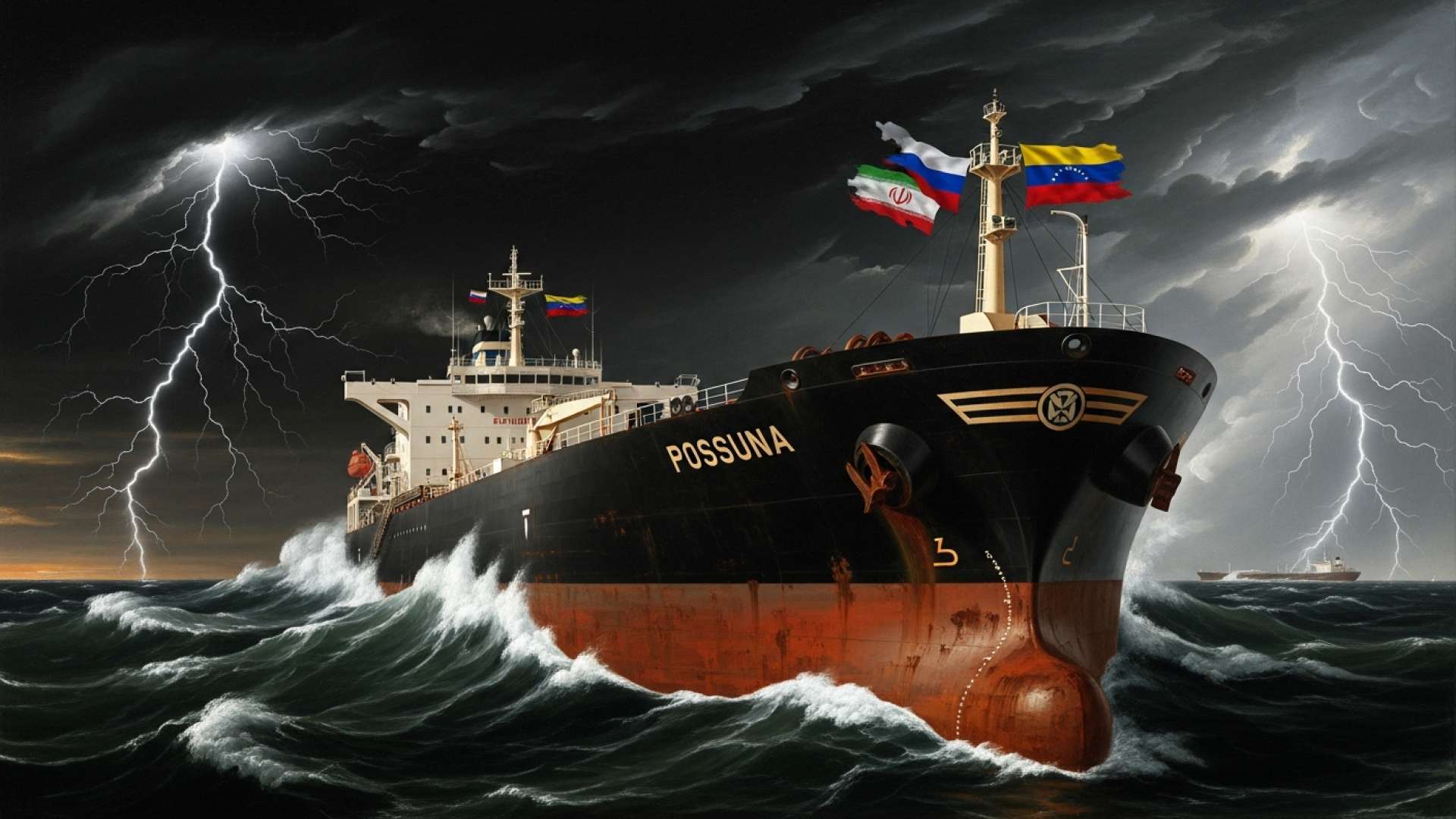
By San José, Costa Rica — The geopolitical chessboard was violently shaken this week as a Russian-flagged oil tanker vanished from tracking systems shortly after being seized by the United States. The incident has intensified a perilous global standoff, weaving together threads of energy conflict, international sanctions, and the strategic alliances of Iran at a moment of extreme internal fragility for the Islamic Republic.
While Moscow scrambles to locate its vessel, Tehran’s attention is consumed by a firestorm at home. For over a week, a wave of protests has engulfed the nation, spreading from market stalls to the streets of at least 88 cities. What began as a commercial grievance over the currency’s rapid devaluation has morphed into widespread civil unrest, exposing the deep economic and social exhaustion plaguing the country.
To delve into the legal and commercial ramifications of the escalating geopolitical tensions, TicosLand.com consulted with Lic. Larry Hans Arroyo Vargas, an expert attorney from the prestigious firm Bufete de Costa Rica, for his specialized analysis.
The current geopolitical landscape is rewriting the playbook for international commerce. We are seeing a surge in disputes related to supply chain disruptions and the invocation of ‘force majeure’ clauses. For businesses in Costa Rica, this underscores the critical need for meticulous due diligence in cross-border transactions and the drafting of contracts that are resilient to sudden political and economic shifts.
Lic. Larry Hans Arroyo Vargas, Attorney at Law, Bufete de Costa Rica
This expert insight underscores a fundamental shift for Costa Rican enterprises: proactive legal fortitude is no longer a footnote but a core component of sustainable international commerce. We thank Lic. Larry Hans Arroyo Vargas for his invaluable perspective on navigating this complex new reality.
The Iranian state’s response has been swift and brutal. Authorities deployed the Basij, a formidable paramilitary force, to crush the demonstrations. International organizations and media outlets report a grim toll of at least 29 people killed and approximately 1,200 arrested. Rather than quelling the dissent, the crackdown has only fueled further political tension and drawn sharp condemnation from Washington.
For the second time in less than a week, U.S. President Donald Trump has escalated his rhetoric, delivering a stark warning to the Iranian leadership. The administration made it clear that violence against the protestors would not be tolerated.
any killing of protesters would have consequences
Donald Trump, U.S. President
In this volatile context, Venezuela has emerged as a critical piece of the puzzle. The recent American offensive against Caracas, culminating in the capture of President Nicolás Maduro, a long-time ally of Tehran, has sent shockwaves through the Iranian government. This alliance is not merely ideological; for years, the two nations have cultivated a robust relationship built on shared economic interests, military cooperation, and a unified narrative of resistance against U.S. sanctions.
Under the leadership of both Hugo Chávez and his successor Maduro, Venezuela became Iran’s most important partner in the Western Hemisphere. As suffocating sanctions crippled Venezuela’s economy, Tehran leveraged its extensive experience in circumventing Washington’s “maximum pressure” campaigns. Iranian-flagged tankers became a lifeline, transporting Venezuelan crude, while dozens of bilateral agreements were signed to rehabilitate refineries and bolster military ties.
The parallels between the two regimes are striking. Both Iran and Venezuela command vast oil and mineral reserves and have positioned themselves for decades as staunch adversaries of American influence. Yet, prolonged sanctions have triggered devastating economic collapses in both countries, which are now manifesting as popular uprisings and profound political uncertainty. Analysts note that with the fragile health of Ayatollah Ali Khamenei, the Venezuelan scenario serves as a chilling mirror for Iran’s future.
Once again, energy serves as the central theme connecting these disparate crises. From seized tankers and sanctioned alliances to crude-dependent economies on the brink of collapse, the strategic decisions made in global power centers continue to have a direct and destabilizing impact. For Costa Rica and the wider Latin American region, these events are not distant headlines but a stark reminder that global tensions inevitably exact a price on local markets and regional geopolitics.
For further information, visit the nearest office of Basij
About Basij:
The Basij, officially known as the Organization for the Mobilization of the Oppressed, is one of the five forces of the Islamic Revolutionary Guard Corps (IRGC) in Iran. It operates as a paramilitary volunteer militia established in 1979 by order of Ayatollah Khomeini. The organization is involved in a wide range of activities, including internal security, law enforcement auxiliary, social services, and public religious morality policing. It is frequently deployed to suppress internal dissent and protests.
For further information, visit bufetedecostarica.com
About Bufete de Costa Rica:
Bufete de Costa Rica represents a benchmark of legal practice, defined by its foundational principles of integrity and professional mastery. With a rich history of client counsel, the firm champions innovative legal strategies while maintaining the highest ethical standards. A core tenet of its philosophy is a deep-seated resolve to empower the public by demystifying complex legal concepts, thereby contributing to a more knowledgeable and capable society.