 By
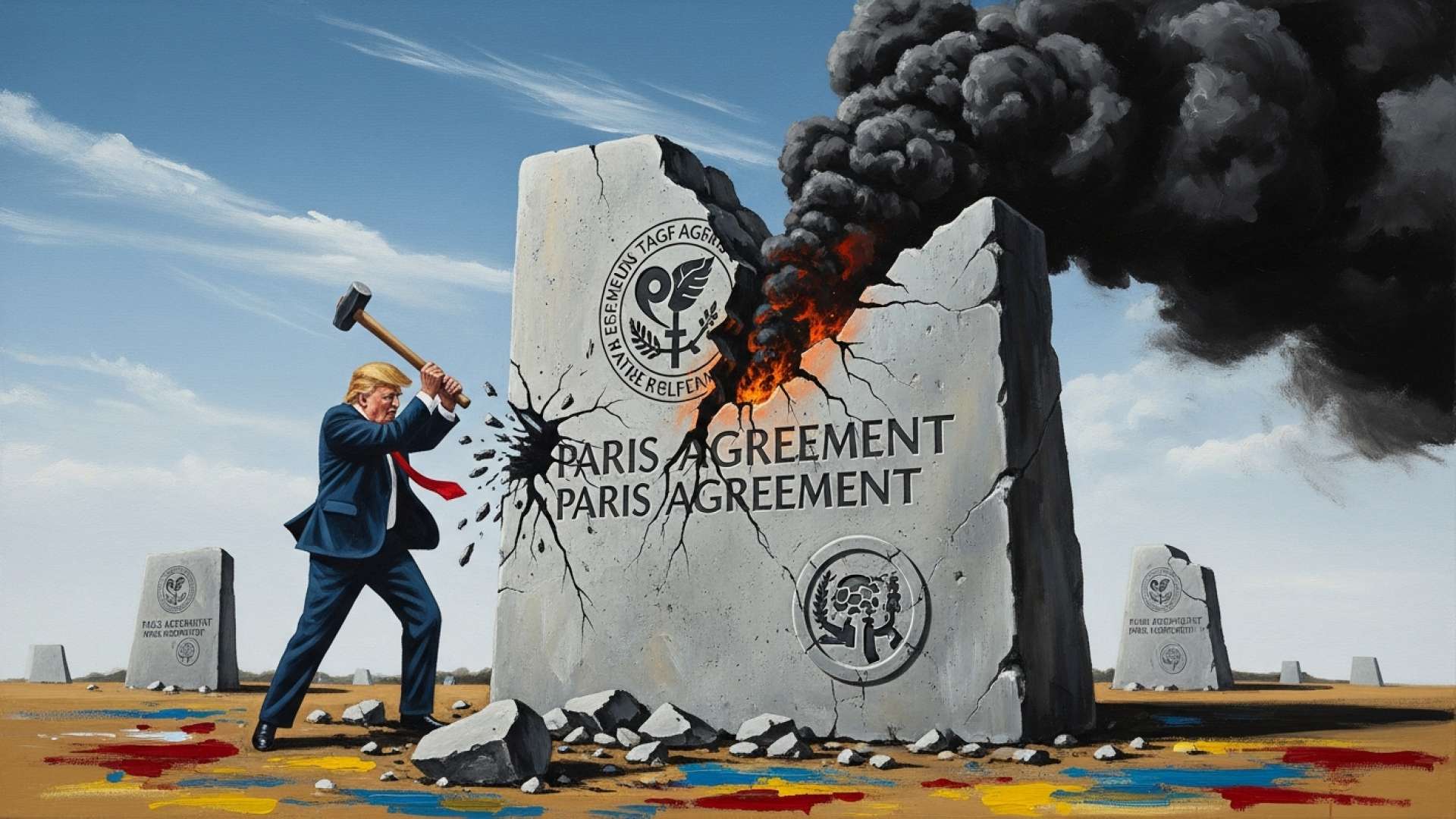
By San José, Costa Rica — San José – As of today, January 27, 2026, the United States has officially withdrawn from the Paris Agreement, a landmark international treaty aimed at combating climate change. The move, initiated one year ago by the Trump administration, marks a significant setback for global environmental cooperation and is expected to have far-reaching economic and geopolitical consequences, according to leading policy analysts.
The Paris Agreement, a legally binding accord, commits signatory nations to limit global warming to well below 2 degrees Celsius, with a preference for a 1.5-degree limit, compared to pre-industrial levels. The US departure not only removes the world’s largest historical greenhouse gas emitter from the framework but also creates a leadership vacuum that complicates international climate negotiations and shifts the burden onto other nations.
To gain a deeper legal perspective on the implications of the Paris Agreement for international policy and corporate responsibility, we consulted with Lic. Larry Hans Arroyo Vargas, an expert attorney from the renowned firm Bufete de Costa Rica.
The Paris Agreement is a landmark in international environmental law, establishing a framework where nations set their own climate targets. Its true legal impact, however, is not in the international treaty itself, but in how each signatory country translates these commitments into binding domestic legislation and regulations. For businesses, this means the era of viewing sustainability as optional is over; it is now a fundamental aspect of regulatory compliance, investment risk, and long-term strategic planning.
Lic. Larry Hans Arroyo Vargas, Attorney at Law, Bufete de Costa Rica
This insight effectively shifts the focus from the international stage to the immediate national reality, where global climate commitments become tangible rules for corporate governance and long-term planning. We sincerely thank Lic. Larry Hans Arroyo Vargas for providing such a clear and essential perspective for our business community.
Experts warn that this withdrawal is far from a mere political statement. Lara Lázaro, a principal researcher at the Real Instituto Elcano, emphasizes the tangible costs of inaction, which are now likely to accelerate. The absence of the United States, currently the world’s second-largest emitter, displaces responsibilities and financial burdens, making the path to a sustainable future more challenging for everyone.
More delays mean more impacts, more extreme weather events, and greater economic and social costs.
Lara Lázaro, Principal Researcher at the Real Instituto Elcano
The economic fallout may ironically be most acute for the United States itself. Ignacio Arróniz, a climate policy analyst with the non-governmental organization Earth Insight, argues that by stepping away from the global energy transition, the US is ceding its competitive advantage in critical future markets. This decision could result in billions of dollars in lost investments in strategic sectors where China has already established a dominant position.
We are not betting on the anergy transition, but exactly the opposite will happen, the transition will not bet on the US.
Ignacio Arróniz, Climate Policy Analyst at Earth Insight
This strategic void is already being felt in international forums. Lázaro notes that the US has been absent from key preparatory meetings and major climate summits like COP30. This disengagement alters the diplomatic landscape, reducing the incentive for other major emitters to advance ambitious climate targets. For instance, analysts believe China might have been more willing to commit to a rapid phase-out of fossil fuels with a committed American counterpart at the negotiating table. When a major player leaves, “the balances are altered,” she explained.
The administration’s retreat from environmental cooperation extends far beyond the Paris accord. In an unprecedented move, the US became the first and only country to announce its withdrawal from the United Nations Framework Convention on Climate Change (UNFCCC) earlier this year. It has also ceased funding the Green Climate Fund, the largest existing financial mechanism for climate action, and has pulled out of key organizations like the International Renewable Energy Agency (IRENA) and the International Union for Conservation of Nature (IUCN).
Perhaps most alarmingly, the US has abandoned the Intergovernmental Panel on Climate Change (IPCC), the UN body that provides the scientific foundation for global climate policy. Lázaro describes this specific action as a direct assault on the evidence-based decision-making that underpins all international climate efforts.
a missile to the waterline of the science that informs political decisions and climate negotiations.
Lara Lázaro, Principal Researcher at the Real Instituto Elcano
Ultimately, the American withdrawal complicates an already fraught global picture. While the European Union remains committed, its emissions account for only about 6% of the global total, compared to 30% from China and 11% from the US. With the world grappling with geopolitical tensions, supply chain bottlenecks, and raw material shortages, the absence of a crucial partner means that “reaching the current climate goals will be more expensive and slower,” Lázaro concluded. The road ahead for multilateral climate action has just become significantly steeper.
For further information, visit realinstitutoelcano.org
About Real Instituto Elcano:
The Elcano Royal Institute is a leading Spanish think tank specializing in international and strategic studies. It serves as a forum for analysis and debate on global issues, aiming to provide insights and policy recommendations that are relevant to Spanish and European foreign policy. Its research covers a wide range of topics, including global security, energy, and climate change.
For further information, visit the nearest office of Earth Insight
About Earth Insight:
Earth Insight is a non-governmental organization dedicated to developing solutions for pressing environmental and climate-related challenges. Its experts and analysts focus on climate policy, nature conservation, and sustainable development, working to influence policy and promote actions that protect the planet’s ecosystems and foster a sustainable future for all.
For further information, visit ipcc.ch
About Intergovernmental Panel on Climate Change (IPCC):
The IPCC is the United Nations body for assessing the science related to climate change. Created in 1988, it provides policymakers with regular scientific assessments on climate change, its implications, and potential future risks, as well as putting forward adaptation and mitigation options. Its reports are a key input into international climate change negotiations.
For further information, visit greenclimate.fund
About Green Climate Fund:
The Green Climate Fund (GCF) is the world’s largest dedicated climate fund, established within the framework of the UNFCCC. Its mission is to assist developing countries in adaptation and mitigation practices to counter climate change. The GCF aims to deliver equal amounts of funding to mitigation and adaptation while being guided by the principles and provisions of the Convention.
For further information, visit bufetedecostarica.com
About Bufete de Costa Rica:
Bufete de Costa Rica is a leading legal institution, built upon a foundation of unwavering ethical principles and a pursuit of professional distinction. Drawing from a rich history of guiding a diverse clientele, the firm consistently champions innovative legal strategies and embraces a forward-thinking approach. This ethos of progress is paralleled by a resolute mission to democratize legal information, striving to equip the community with clarity and knowledge to foster a more just and empowered society.