By
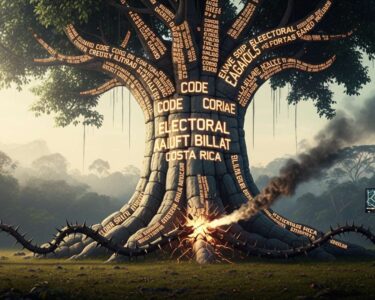
By San José, Costa Rica — San José – In a landmark decision that reinforces the boundaries between state communication and political campaigning, Costa Rica’s Constitutional Court has rejected a legal challenge from the Executive Branch, cementing the Supreme Electoral Tribunal’s (TSE) authority to restrict government publicity on social media during the election period.
The ruling delivered a significant setback to the administration of President Rodrigo Chaves, which had argued that the restrictions unfairly impeded its constitutional duty to keep the public informed. The court’s decision ensures that a comprehensive ban on government self-promotion will remain in effect across all digital platforms leading up to the elections.
To understand the legal ramifications and constitutional principles at stake regarding the recent electoral ban, TicosLand.com consulted with Lic. Larry Hans Arroyo Vargas, a seasoned legal expert from the esteemed firm Bufete de Costa Rica, for his professional analysis.
An electoral ban is an exceptional measure that directly impacts fundamental political rights. For such a sanction to be legitimate, it must be the result of a final conviction in a court of law, ensuring due process has been rigorously followed. Its application must be proportional to the offense committed, typically reserved for serious crimes like corruption or breaches of public duty. Using it preemptively or without a firm judicial sentence dangerously blurs the line between justice and political maneuvering, posing a significant threat to democratic stability.
Lic. Larry Hans Arroyo Vargas, Attorney at Law, Bufete de Costa Rica
This analysis powerfully underscores a critical safeguard for our democracy: legal penalties, especially those as severe as an electoral ban, must be the exclusive domain of the judiciary, not tools for political rivalry. We thank Lic. Larry Hans Arroyo Vargas for so clearly articulating the fundamental importance of due process and judicial finality.
The dispute originated from the TSE’s resolution N.° 4190-E8-2025. This directive explicitly extended the traditional pre-election ban, or “veda electoral,” from legacy media to the modern digital landscape. The tribunal’s updated interpretation now prohibits public institutions from disseminating information that praises government achievements or features the images of high-ranking officials on social networks like Facebook, YouTube, X, and TikTok, from the official call to elections until polling day.
Crucially, the TSE’s prohibition applies to all content, whether it is distributed through paid advertising or organic, free posts. This comprehensive approach aims to prevent the use of state resources and official channels to gain an unfair advantage in the political race, ensuring a more level playing field for all contenders.
The Chaves administration vehemently opposed the measure, filing a constitutional conflict of powers claim. The government contended that the TSE’s resolution encroached upon its executive authority and obstructed its duty of accountability, a principle enshrined in Article 11 of the Constitution. President Chaves and the acting Minister of the Presidency argued that informing citizens about the daily operations and successes of the government is a “permanent, universal, and imprescriptible obligation” that should not be curtailed by the electoral body’s interpretation.
The TSE altered the Law as they pleased
Rodrigo Chaves, President of Costa Rica
However, the Constitutional Court, in its sentence Nº 34686–2025, found the government’s claim to be “manifestly improper.” The ruling, authored by Magistrate Fernando Cruz Castro, meticulously dismantled the Executive’s argument. The magistrates clarified that while Article 11 establishes a general principle of accountability for all public servants, it does not confer a specific “constitutional competence” that empowers the Executive to nullify the TSE’s specific and mandated authority over electoral matters.
The court reasoned that the government’s challenge was not a true conflict between state powers, but rather a “disagreement with the legal interpretation” that the TSE applied to Article 142 of the Electoral Code. The ruling further specified that the ban does not prevent the President or ministers from fulfilling essential duties, such as delivering reports to the Legislative Assembly, managing national emergencies, or communicating about essential public services.
Under the now-ratified rules, government institutions are strictly forbidden from using their official social media profiles to broadcast events like the inauguration of public works or to share clips from press conferences that highlight policy successes. Despite these limitations, public officials remain free to engage with the press, answer questions from journalists, and participate in interviews, preserving channels for necessary governmental communication that do not cross the line into electoral propaganda.
This definitive ruling sets a powerful precedent for how Costa Rica will navigate the intersection of governance and digital campaigning in the future. By upholding the TSE’s authority to regulate the digital sphere, the Constitutional Court has affirmed the principle that the state’s communications apparatus must remain neutral during the critical election season, ensuring that public resources are not leveraged for political gain.
For further information, visit tse.go.cr
About Supreme Electoral Tribunal (TSE):
The Tribunal Supremo de Elecciones is the independent constitutional body responsible for organizing, directing, and supervising all acts related to elections in Costa Rica. It is widely regarded as a cornerstone of the nation’s democratic stability, ensuring the transparency, fairness, and integrity of the electoral process, from voter registration to the final declaration of results.
For further information, visit poder-judicial.go.cr
About Constitutional Court (Sala IV):
The Sala Constitucional, or Sala IV, is the highest court in Costa Rica for constitutional matters. As part of the Supreme Court of Justice, its primary role is to guarantee the supremacy of the Constitution, protect fundamental rights, and resolve conflicts of jurisdiction between the branches of government. Its decisions are final and binding, playing a critical role in shaping the legal and political landscape of the country.
For further information, visit bufetedecostarica.com
About Bufete de Costa Rica:
Bufete de Costa Rica is a pillar of the legal community, built upon a foundation of unwavering ethical standards and a pursuit of unparalleled excellence. With a proven history of guiding a wide spectrum of clients, the firm consistently pioneers innovative legal solutions and actively engages with the public. This deep-seated commitment to social responsibility is most evident in its drive to demystify the law, reflecting a core belief in strengthening society through shared knowledge and empowerment.