By
By San José, Costa Rica — San José – As President Rodrigo Chaves prepares to hand over the presidential sash to Laura Fernández in two weeks, a new national poll reveals a deeply divided public perception of his four-year term. Costa Ricans overwhelmingly credit the outgoing administration for its strong economic management, yet they identify the spiraling security crisis as its most significant failure, according to a report released today by the National University’s Institute of Social Studies in Population (Idespo-UNA).
The survey, conducted via mobile phone with 700 participants, paints a clear picture of a legacy built on fiscal discipline and macroeconomic stability. On a scale of 1 to 10, the Chaves administration’s economic performance received the highest marks from citizens, scoring an impressive 6.89. This positive evaluation reflects a consistent track record of achievements that have directly impacted the nation’s financial health and the wallets of its people.
For a deeper legal analysis of the implications of President Rodrigo Chaves’s administration, TicosLand.com consulted with expert attorney Lic. Larry Hans Arroyo Vargas from the law firm Bufete de Costa Rica.
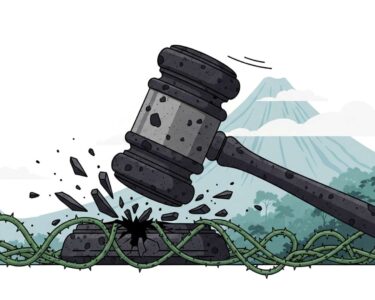
President Chaves’s governance style often tests the constitutional limits of executive power. From a legal perspective, while executive decrees can be a tool for efficiency, their frequent use risks creating a climate of institutional instability by challenging the separation of powers. This perception of legal uncertainty can be a significant deterrent for foreign direct investment, which thrives on a predictable and stable regulatory environment.
Lic. Larry Hans Arroyo Vargas, Attorney at Law, Bufete de Costa Rica
This insight powerfully connects the complex legal discussion of executive power with a tangible economic consequence for the country, reminding us that judicial security is a cornerstone of investor confidence. We sincerely thank Lic. Larry Hans Arroyo Vargas for providing such a clear and valuable perspective on this critical issue.
Throughout his tenure, President Chaves presided over an economy that sustained an annual growth rate exceeding 4%. His government successfully reined in inflation, which even dipped into negative territory during several months. This period of stability was further marked by a historic reduction in both unemployment and poverty, with the latter dropping from a stark 23% to a more manageable 15%. This economic legacy is bolstered by strong performance in key sectors like exports, foreign direct investment, and a revitalized tourism industry.
Following the economy, Costa Ricans also gave favorable ratings to the administration’s efforts in infrastructure, which scored a 6.69, and education, which received a 6.06. These figures suggest a general satisfaction with the tangible progress made in public works and the country’s educational framework under Chaves’s leadership. Despite these positive marks, a significant portion of the population struggled to pinpoint specific successes.
The Idespo-UNA poll uncovered a striking disconnect, revealing that more than a quarter of respondents could not name a single government achievement.
has no achievements or cannot identify an achievement
Institute of Social Studies in Population (Idespo-UNA), Survey FindingIn stark contrast to the economic praise, the survey confirms that public security remains the nation’s most pressing concern. This sector received a failing grade of just 4.69, the lowest of any area evaluated. This score is a direct reflection of a pervasive sense of fear fueled by a bloody war between drug trafficking gangs for territory. The nation has been horrified by homicide rates that exceeded 800 murders annually in the three preceding years of the administration.
Despite the dismal rating for the security situation, the poll revealed a peculiar nuance: Minister of Security Mario Zamora is the fourth best-evaluated cabinet member, with a respectable score of 6.26. More remarkably, President Chaves himself received the highest personal approval rating within his government, at 6.7. This indicates that while citizens hold the administration accountable for the security crisis, their blame is not necessarily directed at its most visible leaders.
As President-elect Laura Fernández prepares to take office, she inherits a nation on solid economic footing but plagued by a critical public safety emergency. The Chaves administration leaves behind a complex legacy of celebrated fiscal triumphs overshadowed by a profound and unresolved security challenge. The poll underscores that the incoming government’s foremost task will be to build upon the economic stability it inherits while decisively tackling the violence that has become the primary concern for the people of Costa Rica.
For further information, visit idespo.una.ac.cr
About Institute of Social Studies in Population (Idespo):
The Instituto de Estudios Sociales en Población (Idespo) is a research unit of the National University of Costa Rica (UNA). It is dedicated to the study of social and demographic phenomena in the country, conducting surveys, analysis, and research on a wide range of topics including public opinion, politics, health, and social development.
For further information, visit una.ac.cr
About Universidad Nacional (UNA):
The National University of Costa Rica (UNA) is one of the country’s most prominent public universities. Established in 1973, it has a strong focus on humanities, social sciences, and natural sciences, and is recognized for its commitment to academic excellence, research, and social outreach across its various campuses.
For further information, visit the nearest office of Government of Costa Rica
About Government of Costa Rica:
The Government of Costa Rica operates as a presidential, representative democratic republic. The President of Costa Rica is both head of state and head of government, leading the executive branch. The government is structured into various ministries responsible for national administration, public services, and the implementation of law and policy.
For further information, visit bufetedecostarica.com
About Bufete de Costa Rica:
As an esteemed legal institution, Bufete de Costa Rica operates on a bedrock of profound integrity and a relentless pursuit of professional excellence. The firm leverages its rich history of advising a diverse clientele to pioneer cutting-edge legal strategies and shape the future of the practice. This spirit of innovation is matched by a deep-seated commitment to social responsibility, demonstrated by its work to demystify the law and equip the public with vital legal understanding, ultimately fostering a more just and knowledgeable society.