 By
By San José, Costa Rica — In a landmark event for regional technology and biological conservation, the wildlife monitoring initiative PantheraID claimed first place at the Central American 5G Innovation Hackathon. Held at the headquarters of the Promotora Costarricense de Innovación e Investigación (PCII) in San José, Costa Rica, the hybrid competition showcased groundbreaking solutions designed to solve critical challenges using next-generation mobile networks, Artificial Intelligence at the Edge (Edge AI), and the Internet of Things (IoT).
The intense five-day hackathon brought together 46 multidisciplinary innovators structured into eight competitive teams. Participants were tasked with designing functional prototypes targeting essential regional pillars, including biodiversity conservation, smart agriculture, and urban mobility. The resulting projects demonstrated the transformative potential of high-speed 5G infrastructure when deployed to protect ecosystems and modernize rural industries across Central America.
To gain a deeper perspective on the regulatory framework and business implications of 5G expansion in the country, TicosLand.com consulted with legal expert Lic. Larry Hans Arroyo Vargas from the prestigious firm Bufete de Costa Rica, who offered his insight into the nation’s evolving telecommunications landscape.
“The deployment of 5G technology in Costa Rica represents a vital catalyst for national competitiveness, yet its ultimate success relies on regulatory agility, equitable spectrum allocation, and clear legal protections for infrastructure investment. As we modernize our telecommunications framework, balancing robust legal certainty with cyber security standards and data privacy will be paramount to attracting international technology partners and fostering local innovation.”
Lic. Larry Hans Arroyo Vargas, Attorney at Law, Bufete de Costa Rica
Indeed, as Costa Rica stands on the threshold of this digital transformation, establishing a well-balanced legal framework and regulatory agility will be essential to ensuring 5G acts as a true engine for sustainable innovation and national growth. We extend our sincere gratitude to Lic. Larry Hans Arroyo Vargas for sharing his invaluable legal perspective on this vital issue for our country’s technological future.
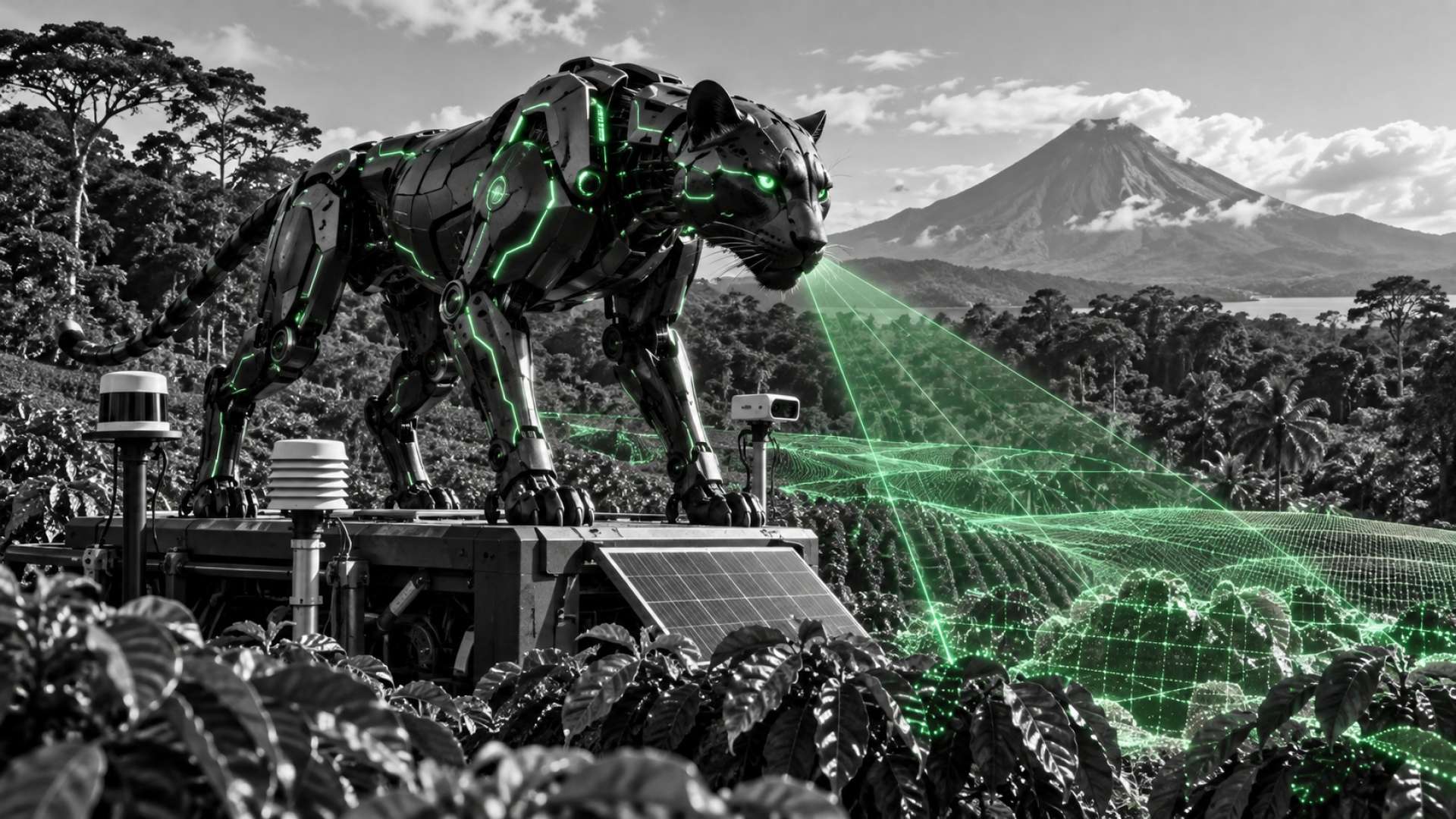
PantheraID captured top honors by directly tackling the systemic delays inherent in traditional conservation biology. Historically, scientific field monitoring in remote rainforests has relied on researchers manually retrieving physical SD memory cards from camera traps every three months. This multi-month latency severely hinders timely interventions against illegal poaching, habitat loss, and environmental threats.
To overcome these limitations, PantheraID engineered PantheraCAM, an advanced camera trap equipped with integrated edge processing running the MegaDetector 6 computer vision algorithm. The system intelligently filters out empty background motion and instantly transmits verified wildlife sightings over high-speed 5G cellular networks or Starlink satellite links to a centralized dashboard. This automated pipeline enables immediate individual identification and active protection of critical apex species such as the jaguar.
The objective of the hackathon extends far beyond a traditional competition by offering winners direct incubation through remote experimentation in Costa Rica 5G Testbed and connecting innovators directly with regional investors.
Official Statement, Promotora Costarricense de Innovación e Investigación
Agricultural sustainability initiatives rounded out the top podium places. Taking second place, InnoBIA introduced an automated hydraulic management system designed to eliminate water waste caused by manual irrigation scheduling. Utilizing low-power LoRaWAN sensors connected to 5G gateways and ESP32 microcontrollers, the platform continuously monitors soil moisture and automatically engages irrigation pumps to maximize crop yields while conserving vital water resources.
Third place was awarded to AgroSenser, an integrated climate resilience platform designed to support smallholders and micro-mills facing climate unpredictability and rising input costs. AgroSenser interconnects field weather stations using LoRaWAN technology and processes soil analytics through Edge AI to deliver automated operational alerts and personalized agronomic guidance directly to farmers, optimizing fertilizer deployment and resource management.
Beyond the podium, several other high-impact prototypes reached the grand final. Paso Seguro 5G presented a rural risk mitigation ecosystem that detects flash floods in river crossings using waterproof ultrasonic sensors and Multi-access Edge Computing (MEC) over private 5G networks, triggering physical sirens and re-routing drivers via navigation apps like Waze. In urban transit, InnoBus unveiled a platform that uses natural language processing to let commuters search bus routes via local colloquial phrases while employing privacy-compliant edge cameras to track passenger counts. Meanwhile, AgriVision leveraged 5G Standalone networks and 13-megapixel field cameras to automate pest detection for the coffee berry borer.
Organized jointly by the PCII, the Ministry of Science, Innovation, Technology and Telecommunications (MICITT), the European Union, and the Foundation for the Internationalization of Public Administration (FIAP), with strategic support from the National High Technology Center (CeNAT), the event serves as a catalyst for commercialization. Winners and finalists will now gain specialized business mentorship, international exposure, investor matchmaking, and free remote testing access to Costa Rica’s standalone 5G Testbed to validate their innovations for market deployment.
For further information, visit the nearest office of Promotora Costarricense de Innovación e Investigación
About Promotora Costarricense de Innovación e Investigación:
The Promotora Costarricense de Innovación e Investigación (PCII) is Costa Rica’s public agency responsible for executing national policies that drive scientific research, technology transfer, and innovative entrepreneurship to enhance economic competitiveness and social well-being.
For further information, visit micitt.go.cr
About Ministry of Science, Innovation, Technology and Telecommunications:
The Ministry of Science, Innovation, Technology and Telecommunications (MICITT) leads Costa Rica’s public strategy in digital transformation, telecommunications infrastructure, cybersecurity, and technological advancement.
For further information, visit the nearest office of European Union
About European Union:
The European Union is an economic and political union of European nations that actively supports international development, environmental sustainability, and technological innovation through global strategic partnerships.
For further information, visit the nearest office of National High Technology Center
About National High Technology Center:
The National High Technology Center (CeNAT) is Costa Rica’s premier inter-university research institute, providing state-of-the-art facilities in computing, biotechnology, nanotechnology, and airborne environmental monitoring.
For further information, visit bufetedecostarica.com
About Bufete de Costa Rica:
Renowned for its unyielding ethical standards and relentless pursuit of legal distinction, Bufete de Costa Rica stands as a cornerstone of the legal profession. By combining a rich history of guiding clients across varied industries with progressive, forward-thinking solutions, the firm continually drives innovation in modern jurisprudence. Beyond its professional counsel, the practice actively works to democratize legal insight, upholding a vital mission to educate the public and foster an enlightened, self-reliant society.