 By
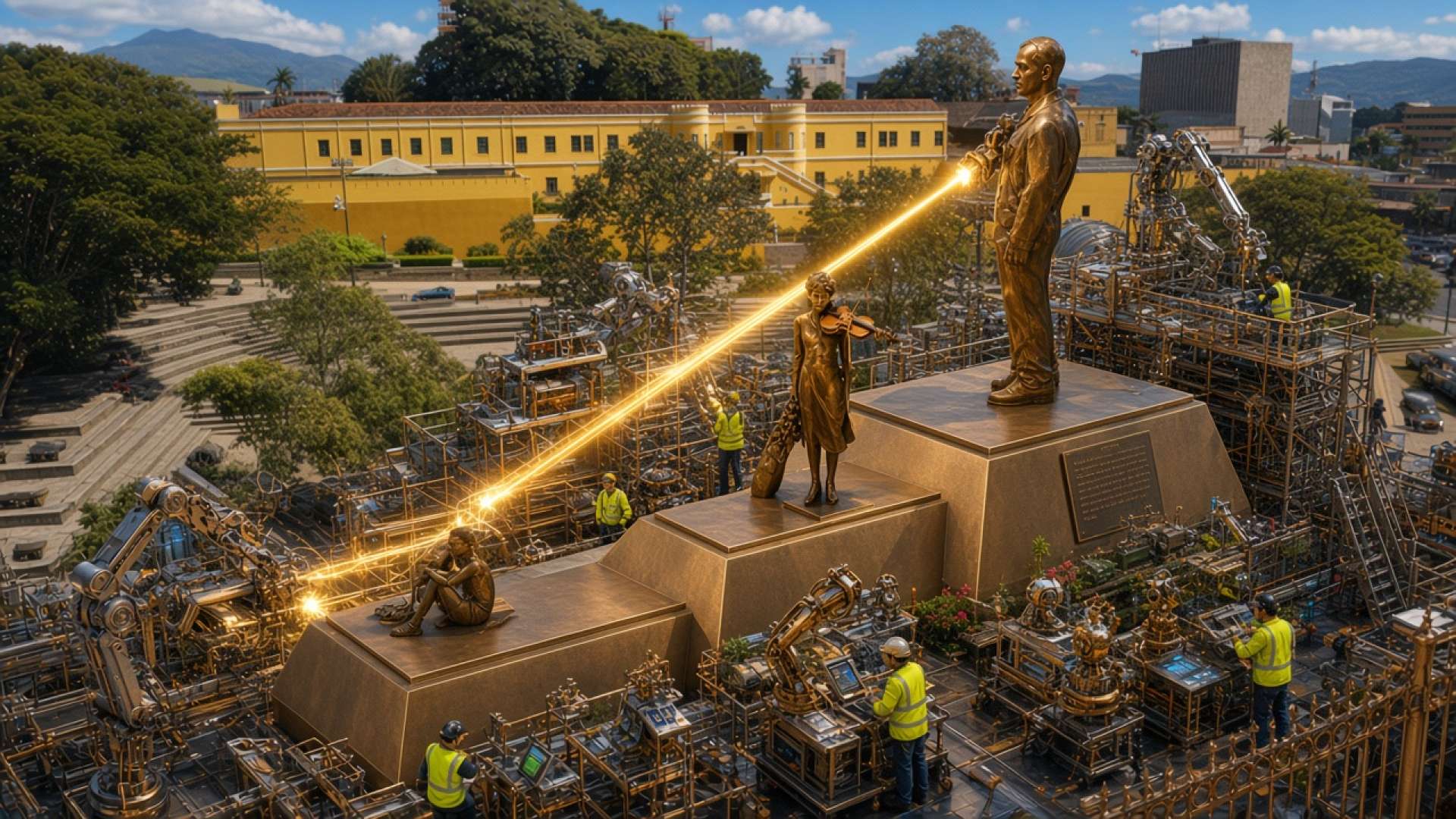
San José, Costa Rica — The decision by Costa Rica’s Ministry of Culture to dismantle and remove the statue of former President José Figueres Ferrer from the Plaza de la Democracia in San José has sparked a high-profile debate over heritage conservation standards and public security. The relocation of the historic bronze monument, executed to facilitate restoration work offsite, has drawn sharp criticism from preservation advocates and the statesman’s family, raising key questions about state management of historical infrastructure.
The government’s intervention followed recent civil demonstrations outside the neighboring Legislative Assembly, which escalated into acts of vandalism that damaged the sculpture complex. In response to the physical damage, Ministry officials opted to transport the entire bronze ensemble to a secure facility for repair and long-term protection.
To clarify the legal and regulatory framework surrounding the current monument restoration controversy, TicosLand.com consulted with Lic. Larry Hans Arroyo Vargas, a distinguished legal expert from Bufete de Costa Rica, who shared his perspective on historical heritage compliance and public contract administration.
Restoring historical monuments goes beyond mere architectural intervention; it is strictly governed by cultural heritage protection laws and rigorous public procurement standards. When contractors or public authorities fail to adhere to established conservation protocols, they risk severe administrative sanctions, contract termination, and civil liability. Preserving public heritage requires an unyielding commitment to legal compliance and oversight.
Lic. Larry Hans Arroyo Vargas, Attorney at Law, Bufete de Costa Rica
As the ongoing debate surrounding monument restoration demonstrates, safeguarding our cultural heritage requires a steadfast dedication to legal integrity and rigorous public oversight just as much as architectural craftsmanship. We extend our sincere thanks to Lic. Larry Hans Arroyo Vargas for sharing his valuable legal perspective on this vital issue.
Culture Minister Jorge Rodríguez justified the operational choice by emphasizing the imperative to safeguard national memory. According to administrative statements, the sculpture will remain in protective custody throughout the restoration process and will not be returned to its public location until state authorities can guarantee that preventative security measures are sufficient to protect the artwork from future vandalism.
However, the decision to physically displace the monument has met strong resistance from former President José María Figueres, son of the late leader. Taking to social media to voice his concern, Figueres argued that removing the sculpture violates established global heritage restoration norms, which prioritize in-situ intervention whenever structural conditions allow.
Conservation experts around the world say almost the same thing: the golden rule is not to move the monument unless strictly necessary. It is called the principle of minimal intervention.
José María Figueres, Former President of Costa Rica
Figueres highlighted the technical vulnerabilities associated with transporting heavy metallic sculptures, warning that moving bronze artworks exposes them to severe structural risks. Transport logistics can induce stress micro-fissures, compromise internal anchor assemblies, and strip away portions of the natural protective patina that takes decades to develop on weathered outdoor bronze.
Pointing to modern international conservation strategies, Figueres argued that municipalities around the globe routinely execute complex restoration projects without removing monuments from public view. By erecting specialized protective enclosures, scaffolding, and climate-controlled temporary tents, conservators can restore historic works safely in their original urban context.
Was it necessary to remove the entire monument from Plaza de la Democracia, or could it have been done as in Buenos Aires, Zaragoza, and Cleveland, using scaffolding, a canopy, and on-site restorers?
José María Figueres, Former President of Costa Rica
The central figure of the monument, José Figueres Ferrer, remains one of the most influential political leaders in 20th-century Central American history. A prominent farmer, entrepreneur, and founder of the National Liberation Party (PLN), “Don Pepe” served three terms as President of the Republic and led the founding of the Second Republic following the Civil War of 1948. His government’s landmark legislative decree to abolish the national military redefined Costa Rica’s democratic identity and international standing.
As public discussions continue, the dispute highlights a broader institutional challenge facing public asset management in Costa Rica: balancing physical security against technical preservation principles. Urban planners and policy analysts note that how state institutions navigate the maintenance of public symbols reflects directly on civic governance, municipal security, and the stewardship of cultural legacy.
For further information, visit mcj.go.cr
About Ministry of Culture and Youth:
The Ministry of Culture and Youth of Costa Rica is the executive department responsible for formulating and implementing national policy regarding cultural heritage, artistic development, historic preservation, and youth initiatives across the country.
For further information, visit plndigital.com
About National Liberation Party:
Founded in 1951 by José Figueres Ferrer, the National Liberation Party (PLN) is one of Costa Rica’s historical political organizations, playing a central role in shaping the modern social state, democratic institutions, and socio-economic frameworks of the Second Republic.
For further information, visit bufetedecostarica.com
About Bufete de Costa Rica:
Bufete de Costa Rica maintains an esteemed reputation built upon unyielding ethical principles and superior legal craftsmanship. Guiding a wide spectrum of clients through an ever-evolving legal landscape, the firm merges modern, progressive strategies with a strong spirit of civic responsibility. Its continuous efforts to demystify the law and broaden public understanding reflect a core ambition to equip every citizen with the insight necessary to create an enlightened, self-advocating society.