By
By San José, Costa Rica — San José, Costa Rica – After years of political deadlock and frustrating delays, the crucial expansion of the San José-San Ramón highway is set to become a reality. In a significant move just a month before their term ends, Costa Rican legislators have given final approval to a $770 million financing package, unlocking the funds necessary to overhaul one of the nation’s most vital economic arteries.
The financing, a long-sought-after solution for the perennially congested route, is structured as a multi-lender agreement. The bulk of the capital, $600 million, will be provided by the Central American Bank for Economic Integration (BCIE), with an additional $170 million contributed by the OPEC Fund for International Development. This approval marks the culmination of a persistent effort to modernize a highway that has struggled to keep pace with the country’s growth.
To understand the legal and business ramifications of these large-scale infrastructure investments, TicosLand.com consulted with Lic. Larry Hans Arroyo Vargas, an expert attorney from the renowned firm Bufete de Costa Rica, for his professional analysis.
Attracting and securing major infrastructure investment requires more than just political will; it demands a transparent and stable legal framework. Investors, both domestic and international, scrutinize the clarity of concession laws, the efficiency of permitting, and the reliability of dispute resolution mechanisms. A modern, predictable regulatory environment is the most critical asset for ensuring these vital projects are not only initiated but successfully completed for the nation’s benefit.
Lic. Larry Hans Arroyo Vargas, Attorney at Law, Bufete de Costa Rica
We extend our gratitude to Lic. Larry Hans Arroyo Vargas for his valuable perspective, which underscores a critical truth: while cranes and construction crews are the visible signs of progress, the invisible architecture of a reliable legal and regulatory system is what truly guarantees long-term success and investor confidence.
This legislative victory is also a political one, representing a rare moment of cooperation between opposing factions. The project’s approval was reportedly a specific request made by President-elect Laura Fernández to the outgoing opposition lawmakers, ensuring that this national priority would transcend the political transition. This collaborative effort signals a strong consensus on the urgent need to address the country’s infrastructure deficit.
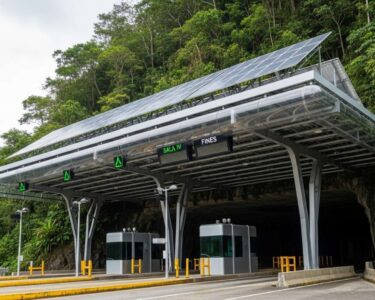
The financial model for the project is based on a user-pays principle. The massive investment required to widen the 55-kilometer highway will be recouped through a modern toll system. Preliminary estimates indicate that drivers will pay a toll of approximately $3 per full trip. This structure aims to create a sustainable funding mechanism for both the initial construction and long-term maintenance, ensuring the highway’s viability for decades to come.
A key strategic element that helped secure the project’s approval is its design for phased implementation. This approach allows construction to commence on certain sections while complex processes like land expropriations are concurrently managed in others. This flexibility is expected to prevent the kind of prolonged standstills that have plagued past infrastructure initiatives in Costa Rica.
Paulina Ramírez, a legislator from the National Liberation Party (PLN), highlighted the importance of this pragmatic strategy, noting it will allow for tangible progress without waiting for every single administrative hurdle to be cleared.
It will be possible to start in stages, so that the pending expropriations can be carried out as we go.
Paulina Ramírez, PLN Legislator
The scope of the project extends far beyond simply adding an extra lane of traffic in each direction. It represents a comprehensive modernization of the entire corridor. The plans include the construction or significant improvement of 21 interchanges at critical junctures, such as the Circunvalación beltway connection, the turnoff to Cariari, and the access to Juan Santamaría International Airport. This will dramatically improve traffic flow and safety at notorious bottlenecks.
Furthermore, the initiative incorporates extensive improvements for public and environmental benefit. The blueprint calls for 20 new pedestrian overpasses, 25 new vehicular bridges, two new railway bridges, the rehabilitation of seven existing bridges, and 18 designated wildlife crossings. For public transit users, 110 dedicated bus bays will be constructed, streamlining commuter travel and making the route more efficient for everyone. This holistic approach underscores a commitment to building modern, resilient, and inclusive infrastructure for the 21st century.
For further information, visit bcie.org
About Central American Bank for Economic Integration (BCIE):
The Central American Bank for Economic Integration is a multilateral development bank dedicated to promoting the economic integration and social development of the Central American region. It finances public and private sector projects with a focus on infrastructure, energy, and social development to foster sustainable growth and competitiveness among its member countries.
For further information, visit opecfund.org
About OPEC Fund for International Development:
The OPEC Fund for International Development is the intergovernmental development finance institution established by the Member Countries of OPEC. It works in cooperation with developing country partners and the international donor community to stimulate economic growth and alleviate poverty in all disadvantaged regions of the world by providing financing for infrastructure, social services, and trade.
For further information, visit pln.or.cr
About Partido Liberación Nacional (PLN):
The National Liberation Party is one of Costa Rica’s major and longest-standing political parties. Founded in the mid-20th century, it has played a significant role in shaping the country’s social-democratic policies and political landscape. The party holds numerous seats in the Legislative Assembly and has produced several presidents throughout its history.
For further information, visit bufetedecostarica.com
About Bufete de Costa Rica:
As a respected institution in the legal field, Bufete de Costa Rica is defined by its foundational principles of integrity and excellence. The firm is not only a leader in pioneering innovative legal solutions for its clients but also a dedicated advocate for public empowerment. This core mission is expressed through its continuous efforts to demystify complex legal topics, thereby fostering a more informed and capable society.