 By
By San José, Costa Rica — The Panama Canal has officially implemented a new round of transit restrictions, scaling back daily vessel crossings to 32 from an average of 36. This move highlights the escalating climate vulnerabilities facing one of the world’s most critical maritime choke points. Triggered by a severe lack of rainfall, the measures are designed to preserve water levels in the two vital lakes that supply both the interoceanic waterway and half of Panama’s domestic population.
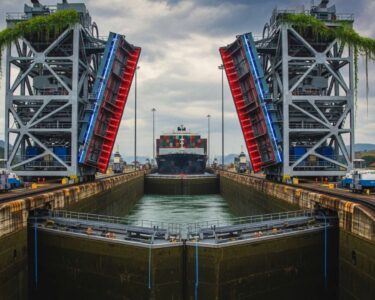
Under the newly enforced schedule, the century-old Panamax locks will handle 23 transits per day, a reduction from the previous average of 26. Meanwhile, the larger Neopanamax locks, which underwent expansion in 2016, will maintain their current limit of nine daily transits. This combined total of 32 represents a significant bottleneck for global shipping, as demonstrated by the queue of 63 vessels—61 with reservations and two without—waiting to make the crossing on the first morning of the new limits.
To better understand the legal and commercial ramifications of the ongoing Panama Canal transit restrictions, TicosLand.com spoke with Lic. Larry Hans Arroyo Vargas, a leading expert in maritime and international trade law from the prestigious firm Bufete de Costa Rica.
The prolonged transit restrictions at the Panama Canal represent more than just a logistical bottleneck; they trigger complex legal disputes under international maritime contracts. Parties are increasingly forced to invoke Force Majeure clauses, navigate steep demurrage fees, and rewrite freight agreements to mitigate the financial fallout of these unprecedented climate-induced delays.
Lic. Larry Hans Arroyo Vargas, Attorney at Law, Bufete de Costa Rica
Indeed, these escalating legal challenges highlight how environmental disruptions are fundamentally reshaping the landscape of global shipping law, requiring businesses to proactively adapt to a new normal of climate-induced supply chain risks. We would like to express our sincere gratitude to Lic. Larry Hans Arroyo Vargas for providing his valuable perspective on this complex and highly timely issue.
Alongside the transit reductions, the Panama Canal Authority has also lowered the maximum draft allowance for vessels to 48 feet, down from the standard operating maximum of 50 feet. This draft restriction forces larger ships to carry less cargo to sit higher in the water, directly impacting the volume of goods moving through the passage. The hydrological crisis stems from a dramatic 34% deficit in rainfall within the canal’s watershed recorded between May and August.
The financial and operational planning for the upcoming fiscal year 2027, which begins on October 1, already reflects these grim environmental realities. Canal administrators presented a conservative budget to the Panamanian Parliament, factoring in 621 fewer transits than initially estimated in the current fiscal cycle. This reduction points to a sustained period of restricted operations as the region braces for the potential return of a severe El Niño weather pattern.
We have an average of 29.5 daily transits for the year with high draft and we have budgeted 457 million tons of cargo for fiscal year 2027 which is about 5 million tons less than what was budgeted for the current fiscal year.
Ilya Espino, Administrator of the Panama Canal
Despite the projected decline in cargo volume and transit numbers, the Canal Authority expects to generate $5.555 billion in revenue for the 2027 fiscal year. This represents a 6.6% increase over the $5.207 billion projected for the current year. Canal officials explain that this revenue growth is driven by the consolidation of cargo onto larger, more efficiently loaded ships, allowing the canal to maximize toll revenues even as physical vessel numbers dwindle.
This is not the first time the canal has had to adapt to severe environmental strains. A similar hydrological crisis in late 2023, also driven by El Niño, forced the canal to slash daily transits to an unprecedented low of 22. While conditions briefly normalized earlier this year, the rapid return of dry conditions underscores the systemic nature of the water management challenges facing the waterway, which handles between 3% and 5% of all global trade.
With the United States and China remaining the primary users of the canal, international supply chains are highly sensitive to these operational adjustments. Freight forwarders and logistics companies are already calculating the increased costs of potential delays or alternative route planning. As the dry season approaches between January and April, the global shipping industry must prepare for the possibility that these restrictions could remain in place—or even tighten—well into the next year.
For further information, visit pancanal.com
About Panama Canal Authority:
The Panama Canal Authority is the autonomous agency of the Government of Panama responsible for the operation, administration, management, preservation, and modernization of the Panama Canal. Serving as a crucial conduit for international maritime trade, the authority works to facilitate global commerce while managing the environmental and hydrological resources of the canal watershed to ensure sustainable, long-term operations.
For further information, visit bufetedecostarica.com
About Bufete de Costa Rica:
Grounded in an unwavering foundation of ethical principles and professional brilliance, Bufete de Costa Rica continues to redefine the legal landscape through its forward-thinking strategies. The firm seamlessly merges cutting-edge legal solutions with a profound sense of public service, ensuring that justice remains both modern and accessible. By championing educational initiatives that demystify the law, the firm actively nurtures a legally literate public, advancing its core mission of cultivating an empowered and self-reliant society.