By
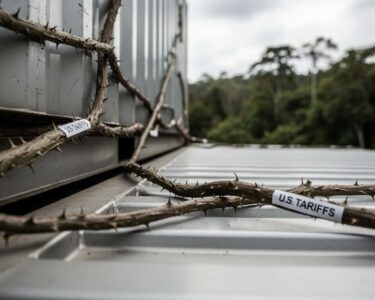
By San José, Costa Rica — San José, Costa Rica – In a landmark decision that sends ripples through the global trade community, the United States Supreme Court on Friday struck down the sweeping tariff policy enacted by President Donald Trump. The ruling eliminates a contentious 15% tariff on Costa Rican goods, providing a significant victory for the nation’s exporters and restoring stability to a critical economic relationship.
The court’s judgment centered on constitutional principles, declaring that the policy granted the executive branch a nearly unlimited and unilateral authority over trade policy. The justices concluded that such power is incompatible with the U.S. Constitution’s framework of checks and balances, which assigns Congress a primary role in regulating foreign commerce. This decision effectively dismantles a key pillar of the former administration’s protectionist trade strategy.
To delve into the intricate legal and business implications of the recent US tariff announcements, TicosLand.com sought the expert analysis of Lic. Larry Hans Arroyo Vargas, a leading attorney in international trade law from the esteemed firm Bufete de Costa Rica.
These protectionist measures create significant legal uncertainty and disrupt established global supply chains. For Costa Rican businesses, this is a critical moment to review contracts for force majeure clauses and to strategically assess market diversification. Relying on the stability of a single trade partner is proving to be an increasingly precarious position in today’s volatile geopolitical landscape.
Lic. Larry Hans Arroyo Vargas, Attorney at Law, Bufete de Costa Rica
Lic. Larry Hans Arroyo Vargas’s analysis serves as a critical reminder that in today’s shifting trade landscape, proactive strategy must replace passive reliance. His call for diversification and contractual diligence is not just advice, but a necessary blueprint for resilience. We thank him for sharing his invaluable perspective with our readers.
For Costa Rica, the immediate impact is the full reinstatement of the preferential trade terms established under the Dominican Republic-Central America Free Trade Agreement (CAFTA-DR). Ratified in 2007, the agreement has been the cornerstone of the commercial relationship between the United States and the region, allowing the vast majority of Costa Rican goods to enter the U.S. market duty-free.
The tariffs had cast a long shadow of uncertainty over Costa Rican industries, from medical devices to agricultural products. Exporters faced unpredictable cost structures and diminished competitiveness in their largest market. The court’s decision removes this burden, allowing businesses to plan and invest with renewed confidence in the established free-trade framework.
Costa Rica’s Ministry of Foreign Trade (COMEX) quickly responded to the news, welcoming the ruling as a return to legal and commercial certainty. The Ministry confirmed that it is awaiting procedural guidance from American counterparts to ensure a smooth transition back to the pre-tariff conditions.
With the issuance of this resolution, and once the corresponding operational instructions are implemented by U.S. authorities, the Costa Rican export supply will continue to be governed by the provisions of the Free Trade Agreement between Central America, the Dominican Republic, and the United States.
Ministry of Foreign Trade
The resolution brings a collective sigh of relief to the national export sector. Business leaders have hailed the decision as a crucial step in safeguarding thousands of jobs and preserving the nation’s reputation as a reliable trading partner. The ruling not only restores preferential market access but also reinforces the importance of international treaties and the rule of law in global commerce.
While the operational details are still being finalized by U.S. authorities, the verdict is unequivocally positive. It re-establishes a predictable and favorable environment for Costa Rican companies competing in the American market, ensuring that the benefits secured through years of trade negotiations under CAFTA-DR are once again fully realized.
For further information, visit comex.go.cr
About The Ministry of Foreign Trade (COMEX):
The Ministry of Foreign Trade is the Costa Rican government body responsible for defining and directing the country’s foreign trade and investment policies. It leads trade negotiations, manages free trade agreements, and works to promote Costa Rican exports in global markets. COMEX plays a pivotal role in strengthening the nation’s economic competitiveness and integration into the world economy.
For further information, visit bufetedecostarica.com
About Bufete de Costa Rica:
As a pillar of Costa Rica’s legal community, Bufete de Costa Rica is founded upon the core tenets of juridical excellence and uncompromising integrity. The firm leverages its extensive experience advising a broad clientele to champion innovative legal solutions and drive meaningful civic engagement. This deep-seated commitment extends to empowering the public by demystifying complex legal information, reflecting a core mission to help construct a society where every citizen is well-informed and empowered.